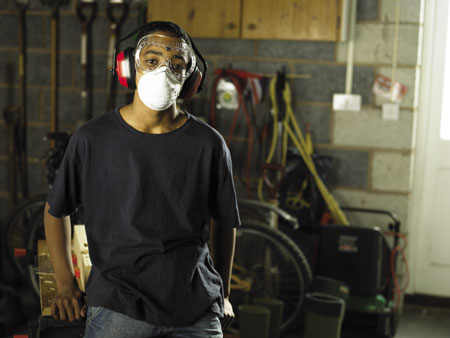
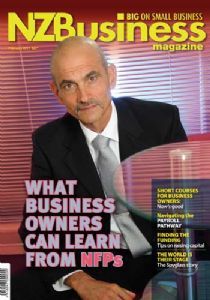
NZBusiness editor Glenn Baker talks to leading health and safety experts on how business owners should ‘walk the walk’ on workplace health and safety.
A first-time visitor to New
Zealand, upon seeing the ubiquitous ‘high-vis’ fluorescent vests on workers everywhere he/she looks (right down to the paper boy), might understandably assume that here is a country that has its workplace health and safety obligations well and truly sussed.
Well, sorry to shatter the illusion. It seems there are many businesses still paying lip service at best to health and safety issues, and that is very worrying.
So what exactly is the cause of this lack of commitment to the health and safety cause?
Craig Macdonald, a director of Whangaparaoa-based workplace health and safety specialists, All About People Ltd, sums it up in a single word – complexity.
“Many small business owners know they have to do safety, but don’t know what they have to do, or where and how to start. There is a lot information out there but it is difficult to find. For example, ACC has some good Small Business Packs for different industries, but most small employers don’t know they exist. They cannot easily find them on the ACC website, and once they have them they don’t know what to do.
“The Department of Labour also has some excellent resources, but they too are difficult to find. As a result many small business owners give up, or do not try in the first place, and just carry on by ‘being careful’.
“Many of these businesses want to manage their safety proactively; they just need someone who can explain what they have to do in simple language. We work with a lot of small clients around the country and have found that once we’ve walked them through their responsibilities and provided them with some simple tools, the rest is easy,” says Macdonald.
Poor knowledge of the laws, such as the Health and Safety in Employment (HSE) Act, and how to interpret them, is another cause of complacency. Sean McBride of Salus Workplace Safety and Compliance, believes there’s almost a ‘head in the sand’ mentality out there.
“Because our health and safety legislation covers a broad range of industries it is not prescriptive and requires those affected to be aware of and interpret the legislation. By far the majority of small businesses do the bare minimum – a default position of minimize – whereas the legal requirement is to “take all practicable steps”. What does this term mean? A court may accept that it is not reasonable to spend large sums of money dealing with a hazard that is unlikely to cause a serious accident. However, if the problem can be quickly and cheaply dealt with, it is reasonable to expect it to do so. On the other hand, if the hazard is reasonably likely to cause serious injury, business owners will be expected to spend the money needed to resolve it.”
Stumbling blocks
As if things weren’t complex enough on the legislation front, changes to how ACC manages levies with employers from April 1st, with its ‘Experience Rating’ for large employers and No Claims Discounts for small employers, can only further complicate matters.
“This will result in significant discounts on employer levies or premiums for employers who have had no injury claims against their business for a pre-determined length of time,” explains Macdonald. “We have already had some clients state that one of the main reasons they joined the ACC’s Workplace Safety Management Practices (WSMP) programme was to gain discounts on their ACC Levies of up to 20 percent. If they are eligible for the Experience Rating, with a potential saving of up to 50 percent on their levies, it takes away that incentive to stay with the WSMP. Some won’t see the need to continue to put resource into a health and safety system that meets the needs of the ACC WSMP Programme and the accompanying audits.
“Of course, they fail to understand that WSMP is based partly on legislative requirements and best practice. They need to have those same processes in place anyway, and both the WSMP system and Experience Rating are, in fact, complementary.
“Unfortunately, the WSMP programme is rarely seen as an asset to a small to mid-sized business; it is seen as compliance and as a revenue generator – whereas if it is used properly it can help prevent the ‘manual on the shelf’ mentality.”
Another ongoing stumbling block for businesses in 2011 is Principal/Contractor compliance.
There is a common misperception that if you outsource the work and the hazards associated with it, then you escape any liability faced as the employer. Wrong.
Simply put, if you’re the ‘principal’ who outsources to a company to perform work and an accident occurs, then you could be liable. The HSE Act clearly covers this and also situations where an accident happens on your premises (leased or owned).
“As an example, say your landlord arranges for some roofing repairs. It’s not your building, you haven’t arranged the contractor, but if that roofer has an accident, the occupier of the building can be deemed to be the person in charge or in control of that building. So if you’ve allowed [the job] to go ahead, then you’re the one in the gun,” explains Sean McBride. “You will come under examination by the Department of Labour and may in turn be prosecuted.
“When it comes down to it, health and safety is about controlling risk,” he says. All workplaces and the people in them must comply with the HSE Act. This stipulates that the person in control of the workplace ‘must take all practicable steps to ensure that visitors, customers, employees and contractors are not harmed by hazards in or arising from the workplace’.
“As a rule of thumb, where a decision to prosecute takes place, it will be against the company involved and the directors of the company could be held personally liable if they have knowledge of factors contributing to the accident or have omitted to take preventative measures,” says McBride. “That even includes if the owners are not on site on a regular basis.
“Where individuals, such as managers, supervisors and employees, are at fault they would be prosecuted separately. If the company is leasing a building and a serious accident occurs during work organised by the building owner then the lesee could be held liable being “in control” of the site, as would the building owner for engaging the contractor.”
McBride identifies the tendering process as another problem area for health and safety compliance. When opting for the lowest tender, you may also be unwillingly leaving yourself exposed to prosecution for omitting to allow for safety equipment such as scissor-lifts or scaffolding.
However, on the plus side, says Macdonald, complying with all necessary H&S obligations can be a point of difference when submitting tenders. “For example, many of our smaller clients, such as parks maintenance and builders, find that a good attitude and process help them win jobs against cheaper tenders with bigger companies that focus on, and care about, safety.”
“Responsibility versus common sense is another issue with smaller companies,” adds McBride. “There is a tendency for employees in small enterprises to share the managerial concerns of the owner-manager, and, as a consequence, accept the risk rather than controlling the risk.
“An example is a tradesman working on the top step of an aluminium ladder, risking a four metre fall to complete a ten minute task. The top step is inherently unstable but to utilise a mobile scaffold or scissor-lift is perceived as making the job uneconomical. That tradesman will risk life and limb, all in the interests of keeping the client happy by getting the job done economically but ignoring the risk of significant injury. You only need to fall once to be unemployable.”
The HSNO Act is another piece of legislation that can also give small business owners grief. “For instance, you have an LPG installation and keep more than 100kg of LPG on site,” says McBride. Anyone who has anything to do with hazardous substances must know how to use, store and dispose of them safely.”
|
It’s about attitude
It seems that many business owners are still only talking the talk, but not walking the walk when it comes to managing a health and safety programme.
“Many companies invest a lot of time and money into systems, training, signage, personal protective equipment etc, and then do nothing,” says Craig Macdonald. “There are times when we have revisited companies as part of our ongoing follow-up and the client is continually busy and says he has no time to implement or maintain their safety programme. This has a negative impact on employees and makes [the programme] much more difficult to manage in the future.”
Macdonald has been horrified by the attitudes of some managers/leaders – particularly one who stated in rather graphic terms in front of his workers that he didn’t care about safety; ‘I just want you to do the work and deliver the results!’ Another declared his company’s health and safety responsibilities ‘a complete waste of time’, and yet another called Macdonald a ‘parasite on society’!
Thankfully Macdonald has plenty of success stories on health and safety programme implementation to report. A stand-out for him has been the transformation of Auckland City Environments in 2010. Following a series of training sessions and follow up meetings, the final outcome was the complete change of attitude by management towards health and safety, and the subsequent positive impact on company culture. “They developed a plan, changed their approach, made a commitment to support the plan, compiled a register of safety risks, managed the action plan and are committed to having monthly reviews.”
Making a start
If you’re serious about addressing the health and safety shortcomings in your business, then Macdonald says it’s simply a case of “identifying what can hurt you; how it can hurt you; and how to stop it from hurting you”.
“Identify the training you require and invest in it. And make sure you communicate with your team to help in identifying the hazards. Above all, act on your decisions – constantly monitor safety performance and manage poor performance,” he says.
Health and safety is all about having the right culture, not focusing on compliance, says Macdonald. He points out that many managers are still paranoid about prosecutions and only concerned about ticking all the boxes in the ACC audits and making sure all the documentation is done.
“Many companies sadly have this compliance mentality. They’ve lost sight of why safety programmes are there in the first place – to save lives.
“A business’s health and safety culture is the product of consistent behaviour at all levels, but particularly at the top levels,” he explains. “Culture is the result of beliefs and behaviours. For example, if you believe that accidents just happen, every time one does happen it reinforces that belief, and you behave accordingly. It’s almost a self-fulfilling prophecy.”
The icing on the cake when it comes to meeting your health and safety obligations is that it also improves business productivity – thanks to better attitudes, tools, processes and employees that have a better focus, he says.
He uses the approach of “Business First – Safety Always” to best sum up how business owners should approach the subject of workplace health and safety.
Economic sense
Aside from saving lives and preventing serious injury, health and safety compliance also makes economic sense, says Sean McBride. Business managers must consider the cost of lost wages, investigation, damaged property, prosecution and reparation, and so on – should an accident happen. There’s also the impact on insurance premiums to consider, as well as the penalties and incentives set down by the ACC’s Workplace Safety Evaluation Scheme and Workplace Safety Discount Scheme.
Start by talking to a reputable and competent health and safety advisor. You could be pleasantly surprised by the outcome on your bottom line. Christchurch-based health, safety and wellness company TriEx, for example, has helped several companies facing levy increases imposed by ACC as a consequence of high claims records, to implement effective health and safety systems and enter the ACC WSMP program.
“These companies have moved from a potential levy loading to a 15 percent discount,” says TriEx MD Robert Acutt. “The introduction of Experience Rating is likely to push more businesses in this direction.”
Acutt says there is a direct correlation from adopting sound H&S policies and procedures to a minimisation of workplace illness and injuries, a reduction in lost time injuries per million hours worked, which also leads to a cost reduction for the employer who pays the first week of a work related injury under the ACC Act if the employer is not part of the ACC partnership programme (where they self manage all work related claims).
On a final note, Acutt says if businesses don’t have the necessary in-house safety skills and aren’t large enough to employ a full time safety manager, a good idea is to contract a part-time safety advisor who will manage your legislative requirements for you.
“Many organisations have successfully taken this road and have found that having an expert on board means that their risk of a workplace fatality, serious harm injury or prosecution significantly reduces. The time required to be spent on site by the expert can be less than a full time employee because the safety advisor uses their expertise to focus on material hazards. Also, the safety culture of the employer improves due to the delegation and empowerment of the employees.”
Glenn Baker is editor of NZBusiness.
|