|
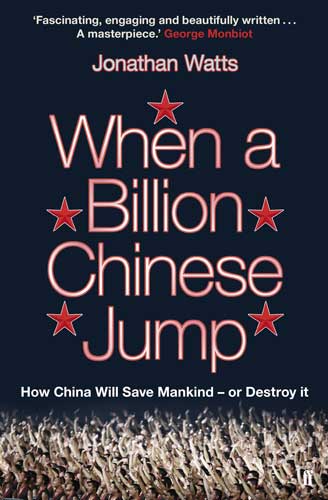
When Jonathan Watts was a small boy growing up in England he used to fret about what would happen to the world if everyone in China jumped at the same time.
Many years on, he’s again worried that actions taken by that vast nation’s billion-plus people affect everyone else on this one planet of ours.
When a Billion Chinese Jump joins a growing stack of weighty volumes on China. Many, like this one, are written by China-based western journalists who blend their professional eye for a good story with a huge sweep of big-picture statistics and sharp observation of what’s happening on the ground.
The Guardian’s Asia environment correspondent Jonathan Watts traces the tension between China’s need to address its appalling environmental degradation while keeping its economic engine high-revving in top gear. Using a travelogue style, he criss-crosses the country from southwest to southeast, northwest to northeast. He probes man’s many ways to dominate, obliterate or mutate nature to our own ends. And he examines President Hu Jintao’s ‘Scientific Outlook on Development’ which stakes the country’s future on design and technology.
Is it possible, Watts asks, for China to overcome its environmental crisis before it’s too late for us all? As he says, “The planet’s problems were not made in China, but they are sliding past the point of no return here.”
Watts flick-flacks the reader between complacency and despair. Just when I dared to hope an environmental catastrophe may be averted, he scared the bejesus out of me with another account of soil laced with toxic metals, of unbreathable air and untouchable rivers.
“It is unreasonable,” he concludes, “to ask China to save the world, but the country forces mankind to recognise we are all going in the wrong direction.”
One small niggle: there’s still a tendency among journalists to believe a big country like China must equate to a big book. Watts is no exception. When a Billion Chinese Jump runs to 392 pages including the afterword. Then there’s another 91 pages of acknowledgements, notes, bibliography and index. It’s all relevant, but I’d got the point way before the ending.
Having said that, if you want to get a grip on one of the most significant dramas playing out in the world right now, read this book.
If you want to understand changing world dynamics and enjoyed Will Hutton’s The Writing on the Wall, James Kynge’s China Shakes the World or Clyde Prestowitz’s Three Billion New Capitalists (which also includes India), read this book.
If you’re an SME owner/manager looking for practical stuff to help you run your business, I’m not sure our usual usefulness scale is the most appropriate one to apply. This book’s value lies in its ability to deliver insights and press home a point. On that scale I’d give it a 9 out of 10.
|