
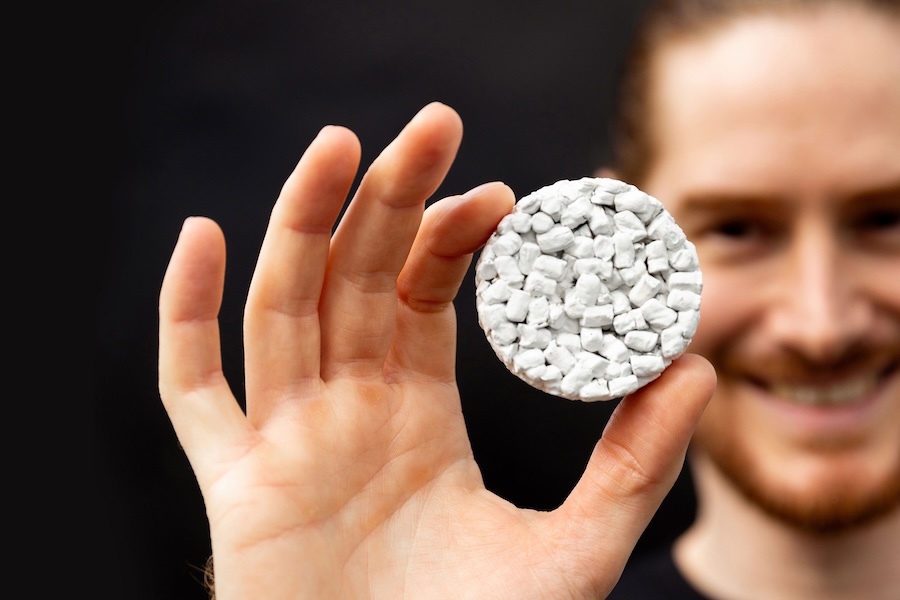

Mushroom Material takes mycelium, the root structure of mushrooms, and mixes it with organic waste. Left to grow indoors and in the dark for about 10 days, the end result is a natural foam with excellent shock absorption. It is also biodegradable and has the same durability as polystyrene but without the harmful environmental impacts, says Mushroom Material founder and CEO Shaun Seaman.
However, three years ago the small business was grappling with the challenges of scaling production.
“We almost dropped the company at that point,” says Shaun.
Mycelium packaging is being developed around the world. The traditional method is to grow the material in molds. For example, if you need protective packaging for an appliance, it has to be grown in that exact form.
“That’s expensive, slow and impractical for mass manufacturing.”
Shaun and his team focused on finding a solution. What if they could pelletise the material so it could be used as the raw ingredient to make packaging in any form?
The first iterations were “big and clunky”, but they slowly refined the process until one day “we pulled out a sample that just worked beautifully,” says Shaun.
“That was enough to put me on a plane to Singapore and come back with $8 million to kickstart the rest of the project.”
The breakthrough wasn’t just technical. It was strategic. By approaching the problem as process engineers rather than biologists, they focused on scalability from day one. Shaun’s background is in mechanical engineering, specifically materials engineering, with experience in product design and management at Fisher & Paykel Appliances.
“If we approached this from a biological aspect, we’d try and figure out how to grow this faster. We didn’t have any of that bias.”
The pelletisation method means Mushroom Material’s product can potentially fit into existing plastic molding machinery. Manufacturers could theoretically swap out their expanded polystyrene (EPS) pellets and drop in mycelium-based pellets instead, keeping their existing supply chains and capital equipment intact.
“We’re building towards that. Right now we can do compression molding for sure. The next question is can we fit directly into EPS molding? That’s the goal.”
Surfer to CEO
The idea for producing sustainable packaging started in 2018 on a beach in Indonesia. Shaun, from a surfing family, went there expecting pristine blue waters.
“Instead what I found was plastic completely covering the ocean, Styrofoam all over the beaches.”
Many sources suggest that polystyrene, also known as Styrofoam, can take at least 500 years to break down. During that process, it fragments into microplastics that contaminate oceans and enter the food chain.
“It was one of those heartfelt moments where I had to stop and think, this means so much to me that I have to do something about this,” Shaun recalls. “And if I don’t, then why would anyone else?”
It was a stint at Entrepreneur First, a startup accelerator in Singapore, that crystallised his thinking.
“Someone in that organisation introduced me to microbiology and specifically fungi. I didn’t know much about it, but as I started learning, I realised it was within my skill set.”
When Covid-19 hit, Shaun found himself in quarantine isolation in Aotearoa New Zealand for six weeks and set himself a challenge to get a job or start a company.
“I really, really didn’t want to have a job,” he laughs. “So it was really good motivation.”
By the end of those six weeks, Mushroom Material was born and Shaun had brought in Jotinder Singh a mechatronics engineer and a former colleague, as a co-founder.
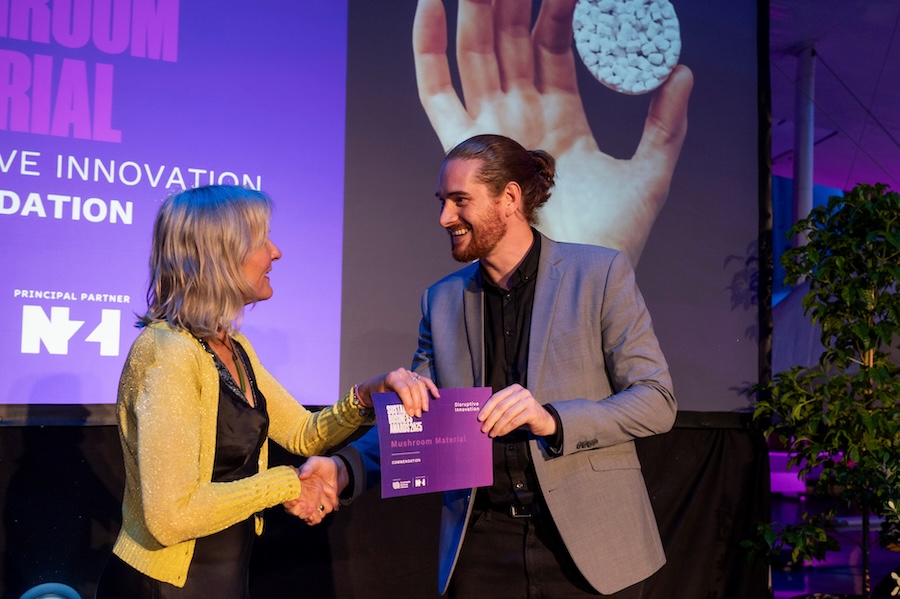
CEO Shaun Seaman receives a Commendation for the Disruptive Innovation Award at the Sustainable Business Awards 2025.
Scaling up
Five years in, the company now operates from a 1,600-square-metre facility with a team of 11. They’ve taken up 60 to 70% of the building already. They use a vertical farming system to save space and improve efficiency. Ideal growing conditions include low, or no light, warmth and high humidity.
Mycelium is added to a layer of organic material like wood chips, hemp, straw, cardboard or food waste. The mycelium consumes the organic material, covering it with a complex series of tiny roots that turn it white. That takes anywhere between five days and three weeks, depending on conditions and the strain of mycelium. It is then dehydrated to stop growth and is ‘cut’ into pellets which look like small marshmallows.
The mycelium pellets will be supplied as a raw product or used by Mushroom Material to make packaging to order. The pellets can also be used as packaging fill, like polystyrene beads.
The business is halfway through building its pilot line. Shaun expects that within the next 18 months they’ll be producing at the level and quality they’re aiming for. They’re preparing to fill their first customer order in January and planning a funding round in mid to late 2026 to build full-scale production.
The challenge now is matching production output to commercial demand. They’ve had hundreds of inbound leads, from small candle manufacturers to household names like IKEA and Samsung.
“For the most part, the large customers want to do trial production runs of large pieces. Their minimum order is 10,000 units. That’s a lot for a small site.”
It’s a good problem to have. The company is focused on building the right foundation now, proving the technology works, then proving it works at scale, before ramping up to full production.
Finding the right people to help scale the operation is its own challenge. The business is looking for mycologists (mushroom specialists) to join the team. With six or seven engineers on staff, they need more biological expertise.
“We have one mycologist now and we’d hire three more if we could find them. The problem is there are not many anywhere in the world.
“We’ve learned how to scale production really well. Now we have to make sure the yield coming out is really good.”
The business has run more than 500 tests to work out optimal growing conditions.
“The entire mushroom industry is trying to minimise root growth and maximise fruit growth. We’re trying to do the opposite.”
New Zealand will remain Mushroom Material’s research and development hub, but Shaun is realistic about where manufacturing will eventually happen.
“It’s a small economy in New Zealand, so we will have small production here. We’ll be manufacturing wherever there are large hubs of production. Southeast Asia, Malaysia to start with.”
While Mushroom Material isn’t actively raising capital right now, Shaun is keen to connect with potential investors.
Mushroom Material received a Commendation for the Disruptive Innovation Award at the Sustainable Business Awards last month. It is on the Sustainable Business Network’s Next list of 2025 awards finalists.