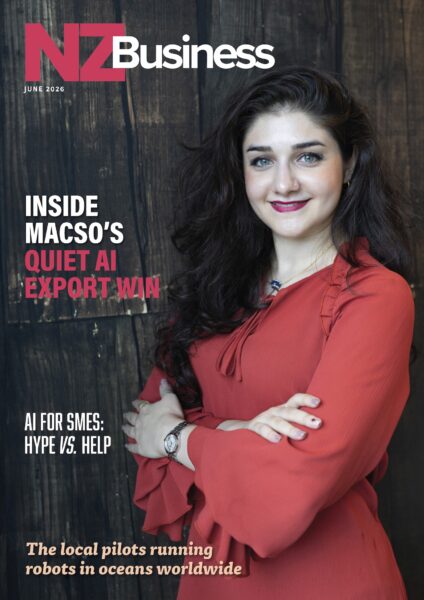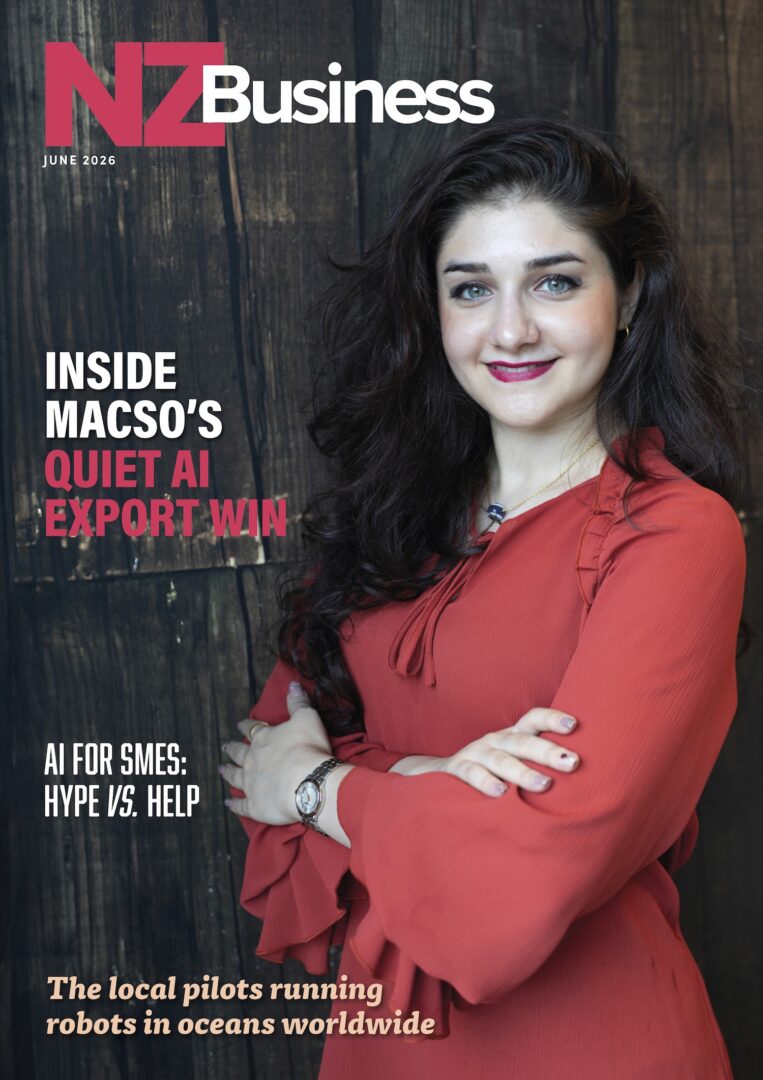


As the Government’s new AI Advisory Pilot rolls out, Nyssa Waters explains where SMEs are missing out on AI gains, and how to turn funding support into measurable business impact.
With small businesses set to access co-funded AI advisory support through the Government’s pilot programme, NZBusiness spoke with Possibl AI CEO and Co-Founder Nyssa Waters about what this means in practice. Selected as an official service provider through the Regional Business Partner Network, Possibl AI is working with SMEs to move beyond AI awareness and into real-world implementation. Waters outlines the biggest opportunity gaps, the fastest-return use cases, and how businesses can ensure AI delivers commercial value, not just new technology.
Q: You’ve said many SMEs already have AI built into the tools they use. Where’s the biggest gap between AI’s potential and how businesses are using it today?
NW: The biggest gap isn’t access to AI, it’s awareness. Most SMEs are already paying for AI capabilities they’re not using. Microsoft 365, Google Workspace, Xero, HubSpot, Canva etc. These tools have embedded AI features that many businesses haven’t switched on or explored. NotebookLM is my favourite example.
Then there’s the next tier: Tools like Microsoft Copilot, Google Gemini, or Claude. For roughly what one hour of labour costs per month, you can give every team member an AI assistant. The ROI is almost immediate if people know how to use them.
The real gap is implementation support. SMEs need practical guidance on which features to turn on, how to prompt effectively, and how to embed these tools into daily workflows-not just a subscription.
Q: What do you expect the Government’s AI Pilot to reveal about SME readiness in New Zealand?
NW: I think the Regional Business Partner AI Pilot will reveal that readiness isn’t about technical capability or budget, it’s about mindset and guidance.
SMEs who approach this with a clear problem to solve, rather than “we should do something with AI,” will see results quickly. Those who treat it as a technology project rather than a business improvement initiative will struggle.
Q: For time- and cash-strapped businesses, which AI use cases are delivering the quickest, most tangible returns?
NW: Two areas are delivering fast, measurable results right now.
First, voice AI agents. Inbound agents that handle appointment bookings, answer FAQs, or route enquiries, and outbound agents that follow up with customers, confirm bookings, or chase invoices. These can be built around your existing processes and start delivering value within weeks, not months.
Second, document and data processing. Think about all the unstructured information flowing through a business such as scanned forms, handwritten notes, PDFs from suppliers. Vision AI can now extract and structure that data automatically. We’re seeing auto shops digitise paper job cards, trades businesses process site forms, and professional services firms automate document intake.
Both of these target high-volume, repetitive tasks where the time savings are immediately visible on the bottom line.
Q: With funding capped at $15,000, how can businesses ensure AI projects stay commercially focused rather than becoming “nice-to-have” tech?
NW: $15,000 is actually a solid starting point if you’re focused on outcomes rather than building something from scratch.
The key is picking a use case with a measurable pain point, such as hours spent on a task, calls missed, errors in data entry-and designing a solution that addresses that specific problem.
It’s also important to remember that AI rarely works in isolation. To get real outcomes, you typically need to connect it to other tools, think your CRM, booking system, or accounting software. Part of that budget should go toward integration and process review, not just the AI component itself.
The businesses that treat this as seed funding for a validated approach – something they can expand once they’ve proven the value – will get far more out of it than those chasing flashy technology.

Nyssa Waters.
Q: Many businesses stall at strategy. How does Possibl AI ensure AI ideas are implemented and used day to day?
NW: We’re obsessive about implementation. Strategy without execution is just expensive documentation.
Our approach starts with the end-to-end process, not the technology. Before we talk about AI, we review how work actually flows through the business, not just the steps that might change, but everything around them. AI inserted into a broken process just speeds up the mess.
Then we focus on adoption. That means involving the people who’ll use the solution from day one, designing for how they actually work, and providing hands-on support until it’s genuinely embedded.
We also stay engaged beyond go-live. AI solutions need monitoring, tweaking, and sometimes retraining. The businesses seeing sustained value treat AI as an ongoing capability, not a one-off project.
Q: What are the most common concerns around data, privacy and trust, and how can SMEs address them without slowing innovation?
NW: The three concerns we hear most often are: “Where does my data go?”, “Can I trust the outputs?”, and “What about my customers’ information?”
These are legitimate questions, and the good news is they’re increasingly manageable.
For data sovereignty, many AI tools now offer options to keep data within specific regions or even on-premises. SMEs should ask vendors directly about where data is processed and stored. Reputable providers will have clear answers.
For trust in outputs, the key is keeping humans in the loop, especially for anything customer-facing or high-stakes. AI should augment decisions, not replace judgment. Start with internal use cases where you can validate outputs before rolling out to customers.
For customer data, treat AI implementations like any other system handling sensitive information. Apply the same privacy principles you already follow, just make sure your AI tools and any integrations meet those same standards.
Q: The Government says AI could add $76 billion to the economy by 2038. What needs to change for SMEs to help unlock that growth?
NW: Three things need to shift.
First, accessibility. SMEs need practical pathways to adopt AI, not just funding, but guidance, templates, and case studies from businesses like theirs. The pilot programme is a good start, but we need more on-ramps for serious AI innovation – not just using AI but embedding AI into products, solutions, services to improve both the top line and bottom line.
Second, skills. This isn’t about training everyone to be AI engineers. It’s about building confidence to experiment, prompt effectively, and evaluate whether AI outputs are fit for purpose. Basic AI literacy should be as common as spreadsheet skills.
Third, mindset. The $76 billion figure assumes AI becomes embedded in how businesses operate, not a side project, but part of the core. That means moving from “AI is coming” to “AI is here, and we’re using it.”
The opportunity is massive, but it requires thousands of SMEs each capturing incremental gains-hours saved, errors reduced, capacity freed up. That’s how the number adds up.
Q: For owners who think AI isn’t for them, what would you say, and what’s the first practical step?
NW: I’d say: You’re probably already using AI without realising it. Every time Gmail suggests a reply, Xero categorises a transaction, or your phone transcribes a voicemail-that’s AI. The question isn’t whether to use it, but whether to use it intentionally.
The first practical step? Pick one repetitive task that frustrates you or your team. Something you do every day that feels like it should be easier, responding to the same enquiries, chasing the same information, entering the same data.
Then try one of the general-purpose AI assistants like Claude, ChatGPT, Gemini-on that task. Don’t aim to automate it fully; just see if AI can take 20 minutes down to five. Start small, learn what works, and build from there.
The businesses thriving with AI didn’t start with a grand strategy. They started with curiosity and one annoying problem.
Q: There’s a lot of talk about AI agents. What does that actually mean for SMEs, and when will it become practical?
NW: Agents are AI systems that can take actions, not just answer questions – booking appointments, updating records, sending follow-ups. For SMEs, the practical version of this is already here in specific use cases like voice agents and workflow automation.
The next few years will see these capabilities become more connected and autonomous. Imagine an AI that doesn’t just draft a quote but sends it, follows up, and updates your pipeline. We’re building solutions like this now, taking what used to require a consulting team and making it accessible as a scalable tool.
The SMEs paying attention now will be the ones ready to adopt these capabilities as they mature.