

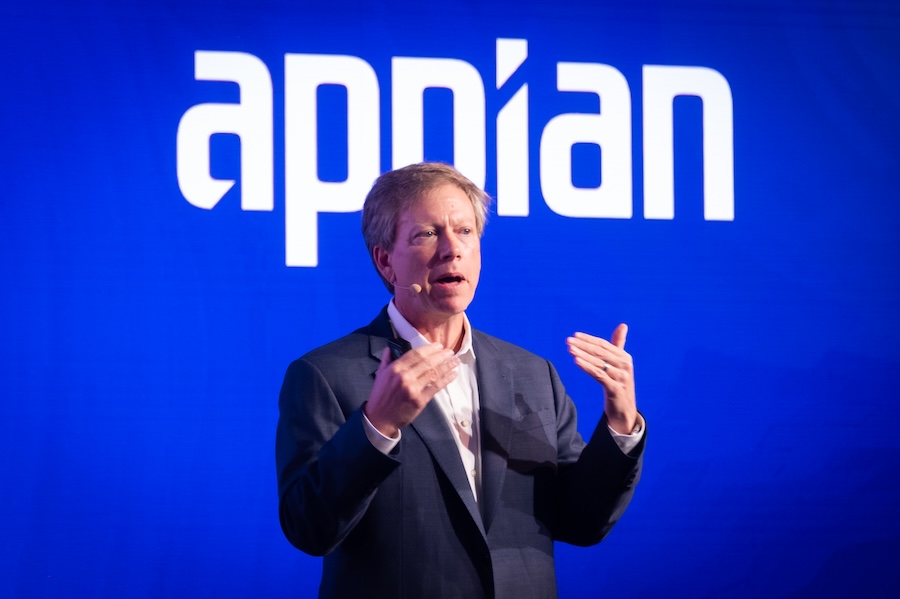

Pictured above: Marc Wilson.
While most New Zealand organisations are experimenting with artificial intelligence, few are realising its full potential. Appian Founder and Chief Executive Ambassador Marc Wilson says the real value of AI isn’t in flashy tools or side projects, it’s in embedding intelligence directly into the processes that run the business, driving measurable efficiency, resilience, and growth.
Artificial intelligence (AI) is no longer a futuristic concept for New Zealand businesses, it’s a strategic tool transforming how your organisation operates. But while most Kiwi businesses are now experimenting with AI, few are realising its full value. According to Datacom’s 2025 State of AI Index, 87 percent of New Zealand organisations are using some form of AI, yet only 12 percent have scaled it across the business.
Appian Founder and Chief Executive Ambassador Marc Wilson believes the gap between experimentation and impact lies in how AI is being applied.
“People think there’s an intrinsic value to AI that naturally accrues at the enterprise level,” says Wilson. “But the experience up to this point shows that’s not necessarily true. The real value comes from what AI does to enhance the processes and the way organisations work.”
Wilson recently visited Australia to attend the ‘Appian Around the World’ event series in Sydney which focused on “Bringing AI to Work”. Across markets, he says the enthusiasm for AI is universal, but so are the pitfalls.
“The positives and negatives are exactly the same. The same pitfalls that Australian or New Zealand companies are going down are the ones that American companies have gone down. People know they need to be doing AI, they just don’t know what it’s useful for.”
A tool in search of a problem
Many businesses, he believes, are approaching AI backwards.
“Too many organisations are seeing too many failures in their AI approaches because they’re basically going into it saying, ‘Oh, we should do AI.’ It becomes a tool in search of a problem,” says Wilson.
Instead, businesses should start with their objectives, not the technology.
“The organisations that are being most successful are changing that mindset. They’re saying, ‘Let’s look at where our problems are, where we can make improvements, and then ask how AI can help us achieve those goals.’”
For Wilson, the biggest wins often come from the least glamorous applications, what he calls “boring AI”.
“A lot of people think AI is going to be the brain that takes over the business. But the most profound successes have actually been in areas like document processing. It’s not sexy, but we’re seeing organisations reducing onboarding times by 90 percent or more, or processing insurance policies 95 percent faster. That’s strategic value.”
These kinds of embedded, process-level improvements are what he says distinguish hype from true transformation.
“When AI is built into the workflows that run the business, that’s when it stops being a helper on the sidelines and starts driving real value.”
A major barrier to scaling AI, especially in regulated environments, is trust. Wilson says that embedding AI within defined processes provides the necessary guardrails and audit trails to build confidence.
“Nobody in any regulated environment is going to put an AI algorithm at the centre of deciding whether someone gets a loan or a medical procedure,” he says.
“Those are going to be AI-assisted human decisions. But when you build AI into a structured process, you can track what it did, what data it accessed, and why it made a decision. That’s what gives organisations confidence that they’re not operating untethered from reality.”

Marc Wilson speaking at ‘Appian Around the World’ event series in Sydney.
The four buckets of value
Appian’s approach to AI reflects this focus on process-driven impact.
“Our philosophy has always been to partner with firms that have deep domain expertise.
“If you understand the customer’s business – their data, their processes, their strategic drivers – you can make good decisions about where AI can be used.”
He says that large language models are quickly becoming commoditised, which shifts the differentiator from technology to application.
“The real distinguishing characteristic in AI is going to be the thought process that goes into its applicability to particular business problems.”
Here, Wilson speaks about the four different buckets or “flavours” of AI use within business, each delivering a different kind of value.
-
Personal productivity AI
This is the AI most people are familiar with. The ChatGPTs and Copilots that help individuals save time.
“Most of what us as individuals have experienced in AI tend to revolve around what I’ll call personal productivity AI. Are we using ChatGPT or Gemini to help us write an email or come up with a first draft of a report? That’s fantastic, it carves out 15 minutes here, three hours there. But it’s difficult to quantify. I wouldn’t say that’s strategic value for organisations.”
He compares it to the arrival of the Internet or Microsoft Word, a tool that makes you faster, but not necessarily transformative at scale.
-
AI for building and development
This next level focuses on tools that help users build applications, reports, or systems faster.
“These tools help people construct applications or reports faster. They now drive some strategic value, but […] are getting a ton of marketing value.”
He mentions how large vendors like Microsoft and Oracle are leaning heavily into this category because it allows “business users to say, I just need a report that does X, Y, Z” without waiting on developers.
-
Process-improvement AI
This is where Wilson says AI starts to transform how work gets done, improving outcomes and efficiency in measurable ways.
“This third category [asks the question] ‘how am I going to make processes better?’ Better could mean faster, more efficient, or a better outcome.”
He gives examples like AI-powered document processing, where companies have cut average processing times from days to minutes.
“That’s powerful. That’s real evidence of AI improving a process.”
-
Optimisation and analytics AI
The most advanced category he says, is where AI analyses processes holistically to identify bottlenecks and recommend improvements.
“What recommendations can we make to improve processes, bring more resources to bear, or rebalance the workforce in real time to help achieve goals faster?”
He says this is where Appian is seeing growing demand, organisations using AI to analyse and continuously refine the way they operate, not just automate tasks.
His caution: “In the market today is that it’s all grouped together as AI, and then what we’re touching must be good. But everything is not great.”
The next phase: Agentic AI
Wilson believes AI is a great equaliser, giving smaller organisations access to capabilities once reserved for enterprises.
“This is the greatest thing that’s ever happened to mid-size and small organisations in terms of being able to compete,” he says.
He cites an example of Appian client Claim Autism, a small U.S. non-profit. Using AI the organisation cut the time it was taking to connect families with care providers from six months to just seven days.
“It didn’t result in them letting people go – it allowed them to more effectively use the people they have. They can take on more because humans only need to be involved where human judgment is required,” says Wilson.
Looking ahead, Wilson sees the next major shift coming from agentic AI, or intelligent agents that work together to solve problems.
“Agentic AI in a [business] context will see multiple agents working in concert to come to the best conclusion. That’s going to be immensely powerful. Process will stitch together what agents, humans, and integrations each do. That’s what’s going to drive tremendous value.”
His advice to organisations still in the pilot phase is simple: Focus on process, measure outcomes, and iterate.
“It’s really an exercise in being objective about how a process is working, understanding the bottlenecks, the goals, and committing to continuous improvement,” he says.
“There’s not going to be one AI flavour in any firm. You’ll have different AIs in different places, and you have to embrace that.”
For New Zealand businesses, that means the next phase of AI maturity won’t be about adding more tools, it will be about embedding intelligence directly into the systems and processes that make their businesses run.
As Wilson sums it up: “AI isn’t about replacing people or layering on shiny technology. It’s about making processes smarter, and that’s where the real scalable value lies.”