
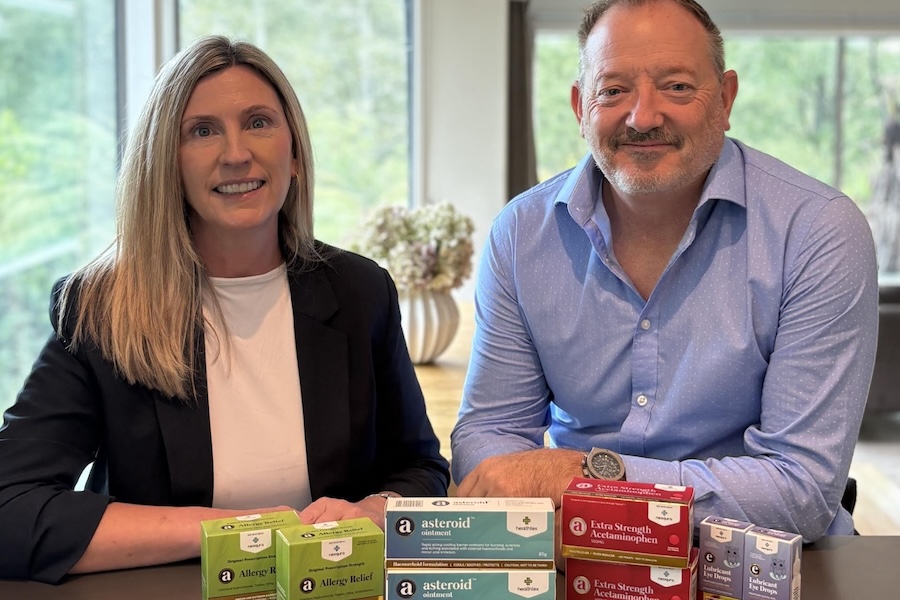

Talk to Tim O’Donoghue about his new company for ten minutes and you realise the pitch isn’t really about ointments, FDA listings or Amazon optimisation. It’s about the patient, and the bigger picture. And according to him, this all centres around self-care.
“If we lift the level of self-care at the primary level,” he says, “we take pressure off GPs, off primary care, off emergency departments. In New Zealand, where the system is under serious strain, that matters.”
Self-care – the bits of healthcare you can manage yourself, with the right product, the right information, and a bit of confidence – Tim says has been the upswing in international pharmacy for two decades. The products, he says, simply haven’t kept pace.
Tim trained as a pharmacist and worked across New Zealand and Australia before heading to the UK, where he locumed his way around dozens of pharmacies and got to discover first-hand what was wrong with a lot of them.
“I was drawn to the self-care part of pharmacy from the start of my career. People would come in and ask, ‘What can I have without going to the doctor?’ But the products either weren’t there, or they were locked behind a prescription, or the advice was thin.”
In 1999, alongside Kiwi pharmacist John Foreman, he co-founded Green Light Pharmacy in central London. The proposition was unfashionable for its time, a pharmacy that would do prescriptions and self-care brilliantly and leave the sundries to other shops.
It worked. Green Light is now a 22-branch group across central London with around 300 staff. In May 2026, Sigma Healthcare – the parent of Australia’s Chemist Warehouse – picked Green Light as its joint-venture vehicle for entering the UK market. Foreman remains Green Light’s CEO. Tim is still on the share register but his head is firmly on Healthtex.
The story of Healthtex began somewhere in the middle of building Green Light, Tim went back to university to do a master’s degree, researching why people did (or didn’t) take their medicines. He interviewed hundreds of patients from all over the world.
“It was fascinating and it was life-changing. People were profoundly unhappy with what was on offer. One problem kept coming up, over and over, haemorrhoids. Three in four adults will have the issue at some point. Nobody talks about it. The products were uncomfortable, hard to clean, didn’t last, and looked like something out of a hospital.”
The way the products were named, Tim says also didn’t help. “All those Ano-this and Procto-that names. People didn’t want any of that anywhere near their bathroom.”
Patients would arrive at the counter and apologise before they even described the problem. So Tim did what pharmacists used to do, he started compounding his own formula. Patients came back. They brought friends. Over years, a clinical-trial-by-instinct emerged, shaped almost entirely by what sufferers told him they actually wanted: Fast relief, a clean and dignified container, packaging they didn’t have to hide.
The name took the longest. “A full decade,” he says. “The day we hit on Asteroid we knew it was a legacy name. We trademarked it globally immediately.”
A New Zealand pilot for an American product
By the time Tim and his wife Alice – a former nurse, beauty-therapy entrepreneur and now Healthtex Co-founder – were ready to commercialise the product, they had already decided where it was going. The United States, where Tim says roughly 155 million adults have the condition, where pharmacy is dominated by a handful of legacy brands, and where seeing a doctor is, in his words, “like us going to the dentist – most people simply can’t afford it.”
But before the US, came New Zealand.
“We self-funded the launch here. We treated it like a clinical trial, in market, in pharmacies, not online, where we could see and hear what people thought of it. New Zealand is a similar Western market. If we’d missed something, we’d find out fast.”
Asteroid hit pharmacy shelves nationwide post-COVID and, with almost no marketing spend, sold roughly 50,000 tubes, about $1 million in retail sales. The customer feedback was important. The tube needed to be slightly smaller so it could be slipped into a handbag. So, they made it slightly smaller.
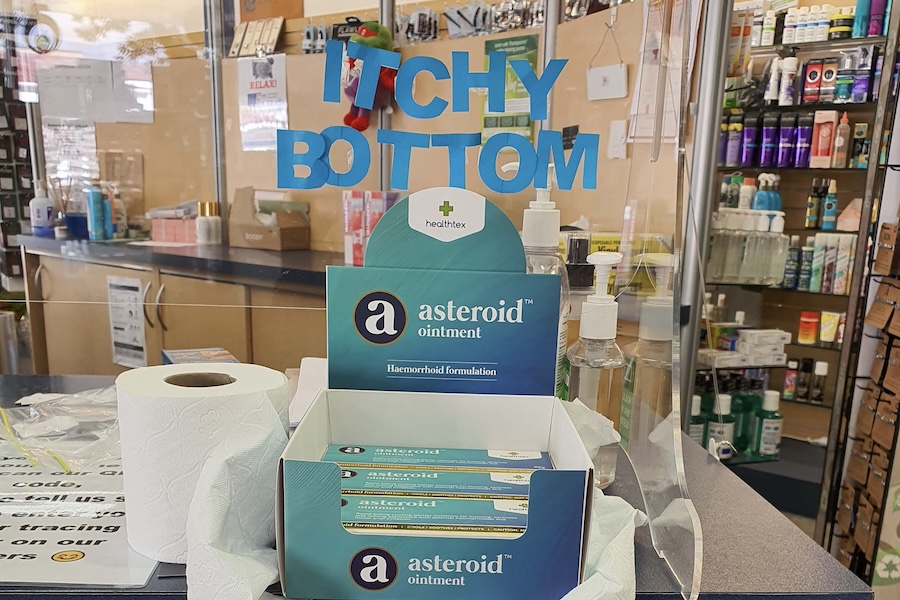
Asteroid counter display in New Zealand.
The other piece, harder to see from the outside, was the FDA. After years of work – and a master’s-degree-era obsession with US drug regulation – Asteroid was granted an FDA OTC medicine listing in July 2025, with what Tim believes is the strongest claim profile in its category: A five-way action and an FDA-registered ‘rapid acting’ claim that, on his reading of the DailyMed database, no other listed topical haemorrhoid medicine carries.
“That was one of those days you’d planned on for twenty years,” he says.
Asteroid went live on Amazon and Neoqura.com in January 2026. From the outside it looks like a launch. In pharmaceutical e-commerce terms, it’s something different.
“You can’t just spend a million bucks on advertising on day one. Amazon makes you earn it. Reviews have to accrue, the algorithm only lets you move at a certain pace. It’s like coming out of pit lane in a Formula One car and not being allowed to go fast.”
So Healthtex used the optimisation window – supported locally by The Optimisers – to do everything else. They submitted Asteroid to Amazon Vine — the platform’s hand-selected reviewers, who can’t be incentivised or directed and whose ratings are public and permanent. The reviews came back a majority five-star. They confirmed Prime eligibility and next-day delivery. They got Asteroid approved for HSA and FSA — the two US pre-tax healthcare-spending schemes that, between them, cover around 35 million Americans.
And, critically, they nailed down a price point.
Before any of the Amazon work began, Auckland pharmacist Mike Guy, a Healthtex co-founder and lead investor who has run a successful US pharmaceutical e-commerce platform of his own for more than a decade, piloted Asteroid into the US market at USD$29.99. It sold. More importantly, customers began subscribing, some monthly. Guy went from validating the price to writing the cheque.
“That’s the moment we knew we had something. When people you’ve never met start subscribing, unprompted, to a product in this category – that’s a model working,” says Tim.
Owning the customer, not the shelf
Asteroid is the entry point, but Healthtex isn’t a one-product business. Behind it sits the Neoqura platform — 13 further FDA-listed products spanning digestive health, analgesics, allergy and weight management, all built so that once a customer trusts the brand with something this personal, they’ll trust it with the rest.
That, fundamentally, is why the company is online-only.
“When people come into a pharmacy you don’t know who they are. You can’t help them next time. We’ve listened to customers for years, and they want anonymity for the sensitive products and convenience for everything else. They want it delivered tonight, not picked up between the school run and soccer practice.”
Physical retail isn’t ruled out forever, “people will always want options, like restaurants”, but the customer relationship lives online, where Healthtex can keep the conversation going. The next major catalyst is the Phase 3 allergy launch in May 2027, timed to the US spring allergy season, and the event Tim believes is most likely to drive a step-change in the company’s value.
The David and Goliath bit
The company’s PledgeMe raise is for $350,000 minimum and up to $2 million, at a $21 million pre-money valuation. The product is built; the FDA work is done; the platform is live. The capital, Tim says, is to “turbocharge” the next phase, the hard launch, the marketing, and the rollout of the next products.
He give an honest assessment that raising capital in New Zealand is hard work.
“It’s a smaller market, and there’s a mismatch when your ambitions are global but your investor base isn’t. In a more sophisticated market (the UK or US) there are far more investors who understand businesses like this. Here, you need resilience. You need huge faith in the product. I don’t think there’s a tenet of raising capital, beyond the obvious, that matters more than knowing, in your own mind, that this thing is going to work.”
Choosing PledgeMe rather than chasing a single institutional cheque, Tim says, “is deliberate”.
“You don’t get to invest in US pharmaceutical companies. They’re owned by the likes of BlackRock, State Street, or Vanguard. There aren’t price wars between pharmaceutical brands the way there are in other industries, and that’s why. So the idea of a New Zealand-owned company being able to disrupt that, and the idea of giving New Zealanders, including people who’ve bought the product and loved it, a way to participate, fits the philosophy of the whole business. We listened to customers to build it. It feels right that they can own a piece of it.”
The company is, to be fair, still a David. FY26 sales were modest while the US scaffolding was being built. The 2027 forecasts step up sharply once the allergy line lands. The risks – capital, competition, currency, the inevitable Amazon ranking algorithm, and the small matter of a 100 percent US tariff on New Zealand-manufactured product – are real, and the Information Memorandum doesn’t dodge them.
But Tim, three decades on from his first conversation with a London patient who couldn’t quite name what was wrong, sounds like a man who has been waiting a long time for this part to start.
“Everything we’ve built has come from listening. The packaging, the name, the formula, the price, the delivery, the channel, all of it. The customer designed it. Now we just have to go and meet them.”
—
Healthtex Holdings Ltd’s PledgeMe capital raise is open May 25 to June 24.