

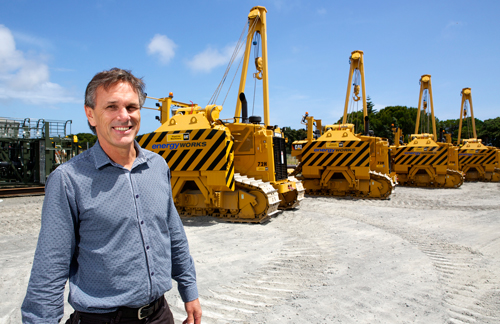

Energyworks is one of Taranaki’s great success stories — a small, locally-owned engineering firm that’s grown to become one of New Zealand’s largest, multi-disciplinary engineering companies servicing the oil and gas industry.
After more than 40 years in business, 2014 marked a turning point in Energyworks’ history, when well-known New Zealand-based private equity group, Direct Capital, acquired a 70 percent shareholding. The acquisition signalled the beginning of a new era for the privately held firm; giving it both the support and financial resources to continue its rapid growth.
So how did this partnership come about?
Nestled amid rolling green pastures, under the restful gaze of Mount Taranaki, Energyworks began life in 1972 as Inglewood Engineering, in the Taranaki dairying town of Inglewood. Then in 2000, Dallas Chadwick, a former farmer, turned welder, who had risen to become general manager, decided to buy the company and take it in a new direction.
“It took me a while to decide to buy it,” recalls Chadwick. “You’re taking on a hell of a thing running an engineering company. There’s a lot of responsibility having 30 staff relying on you. So I made a promise to myself that if I was going to do it, I was going to change it.”
Chadwick’s plan was to refocus the company, relocate it and rebrand it. “I could see where the opportunity was in the energy sector and wanted to shake off that small town, small capacity label that ‘Inglewood’ gave the company,” he says.
Chadwick also made a conscious decision to stop pricing jobs for ‘supermarket steel’ in order to pursue the higher specification energy sector market — a sector Inglewood Engineering had been dabbling with for a few years prior to Chadwick’s acquisition and, given his sage insight, would soon prove to be the company’s bread and butter.
Under Chadwick’s guiding hand, the company concentrated on mechanical work associated with the oil and gas industry, such as piping and equipment manufacture, installation and maintenance. As the small jobs faded away, Inglewood Engineering started picking up more big-name clients.
“We’d do a couple of small jobs for them; do them well and then we’d end up with a major contract. That’s how we really got started,” he says.
Next, Chadwick set about modernising the company’s operations. “We purchased a property in Bell Block, New Plymouth, built a custom facility there and rebranded the company to Energyworks – so a new facility, a new name and completely new focus within five years of purchasing the company.”
The importance and value gained from investing in a new custom facility was huge, says Chadwick. “Obviously there’s value in being more efficient with a better facility, but there are other things that are hard to put a value on; things like brand perception and corporate image. The move to new premises helped turn perception into reality that we really were a company going places.”
Time for some help
Since 2005, Energyworks has been involved in most major oil and gas projects in Taranaki. By 2007, Chadwick realised he needed help and brought in current CEO Allen Clarke as GM to help share the load and develop the maintenance side of the business.
An initial foray into the booming Australian market started with a “hiss and a roar”, he says, only to be rebuffed soon after as the GFC hit home. Chadwick and Clarke retrenched, but kept a toe in the water there by running the Australian business from New Zealand.
Despite this set back, business in New Zealand was powering ahead. The company now employed more than 200 people, but the rapid growth was taking its toll on Chadwick. He admits that as far back as 2005 he was feeling burnt out. His hands-on management style, common among many New Zealand owner-managers, meant he was “just about doing every bloody thing”.
Hiring Allen Clarke had helped, but it also planted the seed that something needed to change. So over the course of the next few years Chadwick began readying the company for sale.
“No one wants to buy a company where if the owner has gone they’ve got nothing left. So I concentrated on building a better management team and putting systems in place so the firm wasn’t so dependent on me. That was 2008, and I guess I’ve been weaning myself off the company ever since. But it wasn’t until 2013 that I actually made a conscious decision to sell.”
Chadwick met investment banking firm Cameron Partners by chance, he says. “They told me about a recent experience with a company sale and my ears pricked up. We talked about a potential sale and I ended up employing them to sell the company.”
It was Cameron Partners’ guidance that introduced Chadwick to New Zealand’s private equity sector. Prior to meeting them he says he’d never have entertained the idea of being involved with private equity. “I didn’t really understand what it was, but I knew I didn’t want the company sold to just anyone. I wanted to know it was going to be looked after. I’ve got a lot of loyal employees here who I want to provide a future for, so it was important that I felt secure that any new owners would want the same thing and Energyworks would not lose its identity.”
Direct Capital met and surpassed all Chadwick’s requirements, allowing him to actually retain a stake in the company, while still gaining the support the company needed to move to the next level of growth. Direct Capital’s team also had experience in successfully taking other New Zealand-owned companies into Australia and Chadwick was keen to do the same.
By January 2014 the transaction was complete, with Direct Capital taking a 70 percent stake, Chadwick retaining a 15 percent stake and Allen Clarke holding the remaining 15 percent.
Travis Sydney, investment director at Direct Capital and now a director of Energyworks, says retaining the immense amount of intellectual property both Chadwick and Clarke bring to the table was a crucial part of the investment.
“Whether we’re a 20 percent shareholder or an 80 percent shareholder we try to act the same and approach the investment as a joint venture with management. We’re not operators of the businesses we invest in so partnering with management teams is important.”
Sydney says Direct Capital sees its role in companies differently to that of management. “We provide an in-house sounding board for the CEO and CFO from a non-industry specific background, but one with a wide private company issue perspective. We don’t get involved in the operations of the company, but look to be actively engaged in areas involving strategy, succession, managing growth, acquisitions and providing financial support.”
As for Chadwick, he says he’s supremely comfortable with the new order at Energyworks. “I’d absolutely recommend business owners who find themselves in my position consider the private equity sector, because you only know what you know. We tend to run businesses with blinkers on. We’re only experts in whatever our business is; we’re not necessarily business experts. So it’s good to tap into the expertise these guys have and learn about business in the big sense.
“Also it’s a lonely thing running a business. There’s a hell of a weight on your shoulders that you don’t tend to realise is there. So if you can share some of that load, it’s good for everyone.”