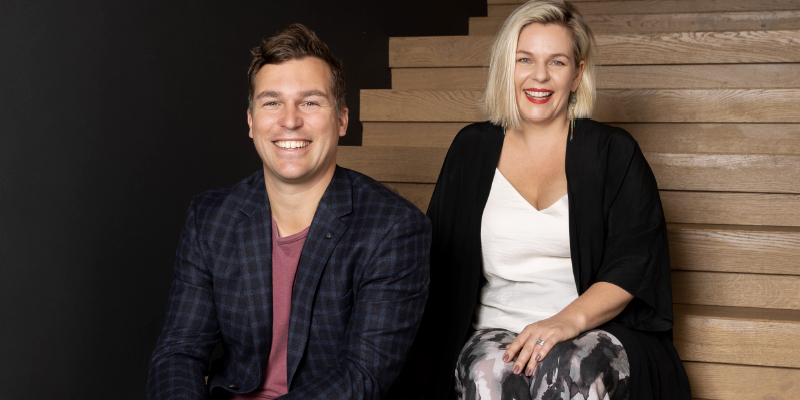

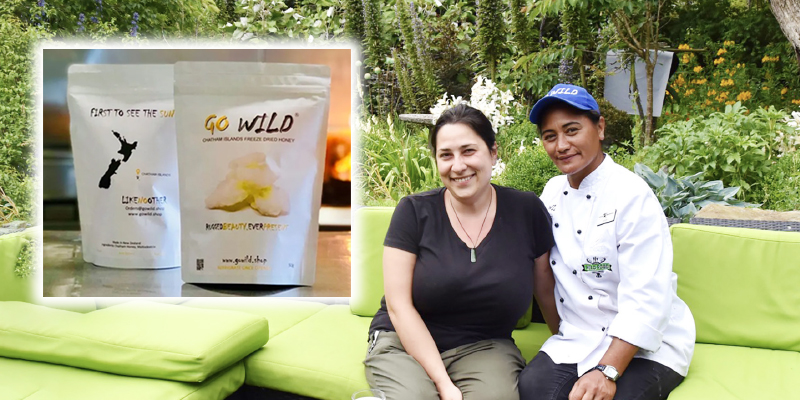

Go Wild directors Francesca Bonventre and Kaai Silbery are the driving force behind a distinctive new freeze dried honey product from the Chatham Islands that has a promising export future.
Remoteness has its benefits. For the Chatham Islands, 800 kilometres off the east coast of New Zealand’s South Island, the benefits for honey producers are a disease-free environment and endemic native plants for the bees – all of which results in a unique red-coloured Chatham Islands honey.
Now, that honey is being transformed into a freeze dried product that chefs everywhere are getting excited about.
Go Wild Chatham Island Freeze Dried Honey has a remarkable back-story and a bright future. It is in a class of its own.
The brainchild of Kaai Silbery, head chef at Hotel Chathams and of Tainui and Ngāti Kahungunu descent, the product was premiered at the Hospitality NZ Championships in August 2018 under the new category of “Chatham Islands on a Plate”. It was an instant hit – the freeze drying process makes the honey light and crunchy and easy to incorporate on dishes.
It’s all about putting the ‘wow’ back into honey, say its creators.
Since the launch, Kaai and her partner, Italian-born Francesca Bonventre, have been busy promoting the product to tourists and marketing it in 50-gram bags online and at the local gift shop. The product has also been promoted through various food events around New Zealand to both introduce and educate the hospitality industry on its merits.
High overheads on the Chathams means that all manufacturing and distribution takes place on the mainland. However, Kaai and Francesca have big initiatives for Go Wild on the islands. These include purchasing some land, rich in vegetation, where they already have beehives.
“We hope to be an example to others on the Chathams around valuing native land and establishing a business that has minimal damage on the ecosystem,” explains Francesca.
“It’s about managing beehives and letting Mother Nature take her course.”
Also on their masterplan is a laboratory where they can extract the honey and welcome visitors; as well as tours where people can learn how the bees came to the Chathams 200 years ago via cargo ships and survived to the present day.
“The idea is to allow anybody, not just on the Chathams but also on the mainland, to support us and participate in our growth through concepts like ‘buy a beehive’, for example,” says Francesca.
“This idea came through several friends or acquaintances asking how they could participate in our adventure. Even visitors have asked how they could become involved more in matters relevant to the Chatham Islands.
“So far Go Wild has raised interest from MPI, Te Puni Kōkiri, James & Wells Innovation Lawyers, Massey University and Rural Women NZ. They’ve all supported us in one way or another,” she says.
“Our priority is building a relationship with the community and local beekeepers involved in producing honey.”
Ciao Chathams
For Francesca, the road from Rome to the Chatham Islands is an extremely long one, and for her life is an adventure.
While she would like to one day resume her ties to her homeland, for now she has her hands full developing Go Wild’s future and partnering with successful entrepreneurs who will help to grow the success of Kaai’s projects, and her own projects.
Meanwhile, the relatively remote location of the Chathams means that each marketing initiative for Go Wild Freeze Dried Honey on the mainland requires careful selection and planning.
Francesca says that they are currently focusing on the Islands’ inbound tourism market as “low hanging fruit” for immediate sales that don’t require large-scale investment.
“For example our Chatham Islands Bee Sanctuary would be an example project for other islands and countries,” says Francesca.
Kaai explains that while their Island nursery is for growing endemic plants and supplying honey to be freeze dried, the Sanctuary project, which she is leading, is the non-profitable wing that is coessential to the business. “To pay back respect to the bees and the environment we live in.”
The intent of the Sanctuary is to increase the population of bees on the Chatham Islands and provide a place where volunteers can monitor the health conditions of the beehives.
“By doing this we can predict there’ll also be increased pollination of local flora with subsequent revegetation,” says Kaai. “Everything is intertwined.
“My project would develop training systems and shared common practices for local beekeepers, to ensure the same standards are followed by anyone harvesting bees, and guaranteeing funding for the younger generations to be trained in beekeeping, or research.”
Kaai says the Chatham Islands can be a place where healthy queen bees and bee colonies can be bred for export, as is already the case, to resurrect bee populations on the mainland or other islands.
Recent MPI tests confirm that the Chatham Islands has one of the cleanest managed honey bee populations in the world. As a result Chatham Island bee samples will be used by MPI as a futures database marker to measure the onset of bee diseases on the mainland and internationally.
Could the Islands even be declared a UNESCO site? Francesca doesn’t see why not.
“The Chathams could become a prototype of excellence for the whole of New Zealand,” she says.