As more Kiwi businesses gear up for expansion, KiwiSpan is delivering future-ready commercial builds that go far beyond basic sheds. NZBusiness caught up with two of the KiwiSpan team to talk about the trends driving the next wave of steel construction.
Steel buildings are having a moment. But this is not just about four walls and a roof. Today’s commercial builds need to be fit for purpose, future-proofed, and delivered fast. For Joel Schrader, owner of KiwiSpan Taranaki, which has two franchises KiwiSpan South Taranaki and KiwiSpan New Plymouth, the commercial shed space is not only busy, it is changing.
From $300,000 trade depots to multi-million-dollar tractor dealerships, KiwiSpan’s pre-engineered buildings are being adapted to meet a growing variety of business needs with speed, precision and increasing design flair.
“We’ve definitely seen a spike in recent months,” says Joel.
“Buildings we quoted on earlier this year are now going ahead. People are starting to feel more confident about 2026 and beyond. They know they need space, and they’re getting on with it.”
Much of the current activity is being driven by the service sector, particularly automotive, agriculture and light industrial businesses that need clear, open-span working areas.
“Panel beaters, tyre shops, tractor dealerships, maintenance crews. These guys are busy, and they need functional spaces to operate,” he says.
KiwiSpan New Plymouth typically delivers projects ranging from $300,000 to $2.5 million. However, it is not just the scale that matters. It is how the space is used.
We’re seeing more demand for mixed claddings, canopies, and roofline variations. People want their building to reflect who they are as a business.”
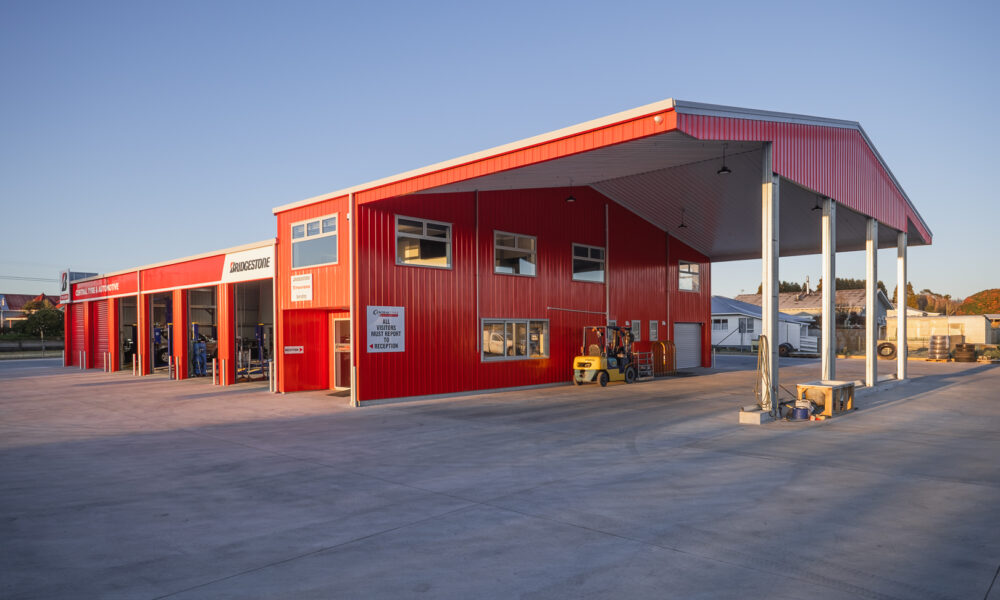
Two recent commercial shed projects stand out for the Taranaki team. The first is a custom Bridgestone Tyres facility in Stratford. The building features large open canopies for truck servicing, two-storey offices and integrated tyre bays. Joel’s team worked with the client from concept to delivery, helping shape a practical and compliant design solution. The team worked with the client from concept to delivery, helping shape a practical and compliant design solution.
The second is a purpose-built facility for Fieldtorque Taranaki, a Massey Ferguson dealership. The original building had become a maze of extensions and outdated structures. KiwiSpan delivered a full replacement that was initially considered larger than necessary. Within six months, the space was already full.

“They thought the building might be too big. But soon after they moved in, they called us to say it was already too small. That’s the kind of growth people are planning for now, Joel says.
He also points to a shift in a commercial shed space, where businesses are no longer seeking just functionality.
“A lot of our commercial clients also want something that looks good. It’s not just a black-and-white rectangle anymore.”
Trends in the commercial shed construction space include:
- Design customisation is increasingly important. Clients want architectural features, not just square boxes. Cladding options, the range of Coloursteel colours, varying rooflines and canopies are common requests.
- Future-proofing is front of mind. Many clients are deliberately building larger than they need, knowing growth is likely.
- Lifestyle crossover demand is rising. Joel calls them “big toy sheds”: high-spec storage and workspace builds on lifestyle blocks that combine functionality with street appeal.
- Speed and reliability remain crucial. Clients want certainty on costs, timelines and outcomes. .
In-house from design to delivery
A major part of KiwiSpan’s advantage lies in its systems. The company’s proprietary design and pricing tool allows near real-time quoting. Its pre-engineered steel system ensures accuracy and speeds up the process of moving from design to delivery.
“All the steel is pre-sized. Once we know the shape and dimensions, we can price it quickly and accurately. That’s a big plus for commercial clients who need to move fast,” Joel says.
Because materials arrive pre-cut, construction on site is streamlined. There is less waste, less weather disruption and far fewer delays.
“It’s not like a house build. There’s no cutting timber on site. You unload the steel, bolt it together and go. Sure, weather still plays a part, but our build times are fast.”
KiwiSpan New Plymouth manages the full project in-house, from early-stage concept drawings to final construction. The local team includes four office staff and 12 to 14 builders. Clients do not need to coordinate multiple suppliers or consultants. Instead, they deal directly with the team managing their build.
Joel says a lot of people buy land without understanding the building code or zoning restrictions.
“We work with them from day one, helping them understand what is possible and cost-effective. We’re the first point of contact. We manage compliance, guide them through consent, and design a building that fits both their needs and the site.”
This level of hands-on support is especially important in the commercial space, where timing, budget and regulatory complexity are often bigger challenges than the build itself.
While some areas of construction have slowed, regional centres like Taranaki have held steady. Joel says 2024 was not a record year, but it was solid, and 2025 looks even more promising.
“We didn’t have to let anyone go. In fact, we hired more staff. Enquiries are up, and there’s more energy in the market again.”
What drives Joel and keeps him happy at work after decades in the trade, is the people.
“I’m a builder at heart, but I’m also a people person. I like helping clients achieve something they’re proud of. Especially the tricky builds – the ones that take more thought and creativity. They’re the most satisfying.”
KiwiSpan’s brand manager Aidan Bartholomeusz says the network of licensees of the business is also growing so fast, and future expansion splans are exciting.
“As our network continues to expand and the commercial side grows, we’re setting our sights on making KiwiSpan a household name. All signs suggest 2026 is shaping up to be an especially promising year for the brand,” he says.


Other Articles