
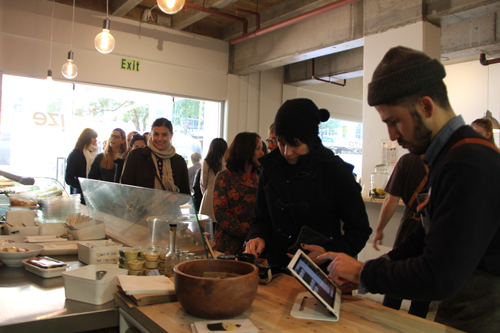

Wellington’s Mike de Lange set out to do something quite different with his salad bar Seize. It’s having a hugely positive effect on the local community.
Ask Mike de Lange what Seize is all about and he’ll explain what they’re not about. “We’re not really a café; we’re not really a restaurant – and we’re not really a juice and salad bar. We see the business as a food start-up which is why we just call ourselves Seize.”
What Seize is – after only months in business – is a success. The best thing to happen on Wellington’s Lambton Quay in quite some time, according to satisfied customers who share their delight on social media. That’s quite an achievement in a city which boasts the highest number of cafés, per capita, in the world.
“We set out with a vision, a concept, and the reception so far has been incredible.” Much of it, says de Lange, is thanks to the “absolutely amazing team” at Seize.
While the absence of a conventional shop counter, and having staff recognise customers and call them by name, help differentiate Seize, de Lange’s focus on evolving, industry-specific technology, plus an emphasis on sustainability, are all equally important in giving it an edge.
Using the latest technology helps streamline the business operation at Seize; de Lange has opted for the cloud-based Posboss point-of-sale system. The low set up cost was one factor that influenced the choice (all that’s needed is an iPad and a printer) as was the fact that developer Jonny McKenzie knows the hospitality industry. “Posboss and Jonny are really innovative and we have very open communication with their guys on what can be done better, how we can make things more efficient on the business side so that it flows through to our customers.
“We’re the instant gratification generation,” admits de Lange. “We want things now but we also want them with a personalised touch. That’s the challenge.”
Technology is also helping to spread the word as customers enjoy sharing that instant gratification with their peers. “We’re seeing a lot of people posting photos of their food on Instagram; voicing their opinion. Social media is more important than many business owners realise. It’s 100 percent driven by consumers and businesses are playing catch-up.”
Sustainability in the hospitality industry is a big issue for de Lange. In this respect, he believes, the sector is far from mature. “Few businesses preach sustainable practices and even less act upon it. We believe you shouldn’t be sustainable because it’s a trend and customers expect it. We should be actively driving it right down the supply chain in hospitality, because if we don’t the planet will fail.
“We don’t bring in pre-made products. Everything we serve is made in our own kitchen. I think it’s our culture that’s getting us so many accolades and incredible responses on social media.” It’s just one of the ways they plan to stay relevant in a market known for its fickleness.
“Seize is a lifestyle brand and this will become more apparent as we build the company.”
Friends to the fore
De Lange graduated from university with an honours degree in business and a long term plan to build an enterprise around food. He worked for several years, first in sales and then in structured finance. However, he recognised that while he understood the fundamentals of running a business, he’d need a lot of help with other aspects of the operation. “We were set up with help from friends – lawyers, our architect, our whole place was built from scratch by friends. At university you develop contacts that become friends and can be a really incredible help in your career.” Value those friends, he says.
“By getting the right people on board you reduce your risk in a venture and I believe doing something new, a little different, rather than doing the same thing over and over again, also means you’re less likely to fail. That’s the attitude we take; managed risk.”
However, there was a fallback plan. “If you fail at a young age (de Lange is just 26) you can always start again.”
The concept behind the business has evolved over a number of years, with the launch just the beginning of a ten year plan. “It’s always been in my head, but it’s putting ideas into practice that’s difficult.”
His first challenge was securing the right location. “Ultimately that’s the foundation; where you want to be to get the best interaction with the customer. And it’s crucial as a start-up that you have a forward-thinking landlord. We were lucky to partner with Robt. Jones Holdings who worked with us to create an atmosphere on Lambton Quay that had been lacking for a while.”
Finding the right people was another challenge for de Lange; building a great team, a huge source of satisfaction. “Hospitality as an industry is reliant on building relationships. Coming in to a place and being welcomed as a friend. People need to treat hospitality and service as more than just a part-time job.”
It’s tough to find talented people, he says. When you do, they need to be good at different things as individuals, but also able to work as part of a team. “That’s my challenge as leader.
“I believe your team comes first and customers are Number Two. That’s a bit counter-intuitive from traditional hospitality thinking but if you have the happiest team greeting customers when they come through the door, the rest of the customer experience is so much easier to handle.”
Laying foundations
His ’10 year plan’ suggests de Lange is there for the long haul, so how could things look in ten years time? “That’s the big question isn’t it?”
They’ve been contacted by people interested in franchising the brand. “That’s a way to grow really quickly, but with less purpose. We’ve also been contacted by investors. And when everything’s going great it’s easy to say yes. But right now we’re learning to say ‘no’, stay purposeful and grow ourselves; build our first Seize with the right foundations.”
De Lange’s not alone in having a great business concept; innovative ideas are something we do well. But he believes we could do better. “Small business drives the New Zealand economy and we have a lot of ideas. But as a community how can we do better? Is it by working together? By building a collaborative environment? I think so.
“If, as a society, we started sharing more resources and ideas, building something together, rather than keeping it in your head for the next two years thinking about how you could do it yourself – imagine how quickly ideas could grow.”
De Lange’s family settled in New Zealand when he was a teenager. He still marvels at our lifestyle and the opportunities it presents.
“To be able to do something different with a small business that has a positive effect in the wider community… it’s incredible.”
Patricia Moore is a freelance business writer. Email [email protected]