

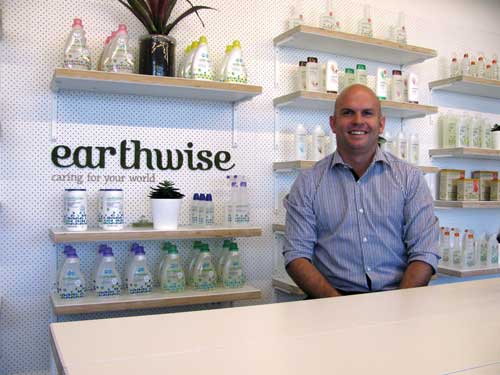

Earthwise is a company founded in New Zealand’s cottage industry of the 60s. Its goal is to become Australasia’s leading environmental brand. Glenn Baker traces a remarkable story.
The day I caught up with Earthwise sales director Jamie Peters he was in the process of signing off on revised product packaging. He proudly points out the ‘Environmental Choice’ logo – the focus of the new packaging and the result of nine months hard work going through the process to achieve the Environmental Choice standard.
It’s just one of a long list of achievements for Earthwise in recent times, including 1000 percent sales growth in the past year, and during our chat Jamie shares a number of other exciting developments that are about to go public.
Before you think Earthwise is some kind of freak overnight success story – first consider that the company and the brand is actually more than 50 years old. In the Waikato, Tom Robinson had started formulating his highly-effective environmentally-friendly and people-friendly products as early as 1964. His products, sold mainly through mail order and niche health products store, had quickly earned a solid reputation. However, by 2010 Tom was in his late seventies and it was time to hand the business on to someone who would value it just as highly and take it to the next level.
As chance would have it, Allen and Jamie Peters were looking for a new challenge at the time. Their highly successful snack company Nice & Natural – which Allen and wife Barbara had founded in 1985 and son Jamie had worked in since university – had long been sold to Griffins.
They wasted no time in purchasing Earthwise and it would prove to be a match made in heaven.
The Peters family inherited hundreds of Tom’s nature-based product formulations. Those formulas still form the basis of around 90 percent of today’s product range – from laundry powders and insect repellents to body lotions. They saw a big gap in the fast growing mass market for environmentally friendly, affordable, yet powerful cleaning and body products. In the supermarkets there were competing premium-priced products, and cheaper ‘green’ offerings that were offshoot brands of large chemical companies but not necessarily with verifiable ‘eco-credentials’.
Jamie says the potential for growth in the mainstream market was plain to see, and with Tom’s sons Jeremy (factory supervisor) and Kayol (formulation engineer) still on board (sadly Tom passed away in mid-2011), they quickly made inroads in the market.
There was much to do: formulations to tweak; a rebranding exercise to take the products into the 21st century; and a lot of marketing to manage – getting the brand firmly established – which was Jamie’s area of expertise.
“One of the biggest challenges initially was scaling up from what was essentially ‘cottage industry’ level to full commercialisation, and getting their heads around a non-food category.” He says they’ve managed to do that without losing the “family, fun” atmosphere within the company.
The authenticity and credibility of the Earthwise products was quickly established in the mainstream market – a major milestone was getting the laundry powders onto the supermarket shelves from October 2010.
Products were pitched directly at mums and household shoppers keen to remove chemicals from the home, be kind to the environment, and make a saving.
Jamie went to work on creating greater product awareness within the community, through Plunket and other community organisations. There’s been a huge amount of marketing done, he says – through much sampling; their Plunket partnership; online shopping sites such as Reach Me; print ads and targeted direct mail.
The overall objective was to market products that equalled those at the top end of the market in terms of effectiveness – but at a price that appealed to the average consumer, who makes up around 70 percent of the market. Judging by the impressive performance of the company in the past 12 months, their strategy has clearly worked.
There’s another important aspect to that strategy too. When Allen and Jamie bought the company in 2010, they developed a simple, lower-cost business model that eliminated several layers of middle men.
Rather than use contract R&D and manufacturing, Earthwise keeps it all in-house at its facility in St Johns, Auckland. It also distributes its products directly to supermarkets and has opted to put its sales teams on the payroll, rather than outsource.
“That means there are no contractors’ margins in any of our products,” says Jamie. “That gives us a cost advantage on most of our competitors. “We’re a one-stop-shop in terms of manufacturing, selling and distribution, which gives us much greater control and flexibility.
“We run an efficient little plant here,” he adds, “and we hold a much lower inventory thanks to the ability to manufacture short-runs. Our stock levels run at about two to three weeks.”
Export potential
Earthwise is poised for its next great growth milestone. With the goal of becoming the leading environmental brand in Australasia, Jamie is close to signing a deal with an Australian supermarket chain that would see Earthwise products available right across the country. “We’re very close to making an announcement,” he tells me.
Tapping the Australian market would be a major coup for the company, although Jamie reminds me that the Australian consumer is not as environmentally aware as New Zealand consumers and there will need to be some serious education in regard to what a ‘green wash’ is. “There’s a bit of work to do, but in terms of exporting, I’m sure we’ll have a success story for you to write about one day soon,” he tells me.
Meanwhile, Allen and Jamie have had their hands full managing the company’s explosive growth over the past year – growth that sees them now turning over more in a month than what they used to sell in a whole year. They’ve done this by investing in skilled people – many from their previous business – as well as “over-investing” in new and second-hand capital equipment. Right now there’s a lot of machinery under-utilised he says because they will need the extra capacity down the track.
With the amount of new product entering the supermarket chains (there are around 40 products in total), sales forecasting is also becoming a real challenge, says Jamie. It tests their inventory levels, although he’s proud to say they haven’t had any ‘out of stock’ scenarios yet.
Making fast decisions is another legacy of this family style business which has put it one (quick) step ahead of the market. “We can have a discussion around the table, make a decision and we’re onto it straight away,” says Jamie. “We’re fast and flexible and we’re not averse to taking risk.”
To prove just how fast they can grow, Earthwise is launching a new health and beauty range in June. This is after Earthwise became the number one environmental laundry brand in a lot of New Zealand’s supermarkets. It is also developing a babycare range for launch in the not-too-distant future.
Is there enough shelf space to accommodate all these products? “Because we’ve had such a great response to our laundry and cleaning products, people now trust the brand,” says Jamie. “And we know they’ll like the new health and beauty products just as much.”
You definitely get the feeling that this is a true hard-working ‘can-do’ Kiwi company. But then that’s hardly surprising when you consider that Tom Robinson was known as the “course I can” guy. What would he think of the company’s progress over the past 12 months, I wonder?
Just quietly, I reckon he’d be pretty chuffed.
Jamie’s quick tips
Do your homework on the market opportunity. Be clear on the gap you are targeting. “We stayed true to our values and there was a clear strategic approach.”
Make sure your products are great and have a key point of difference.
Have a great brand story – “Ours is all about Tom, who was a pioneer of environmental products in New Zealand.”
Pick your long-term partners really well – do they have the same value offerings as you?