
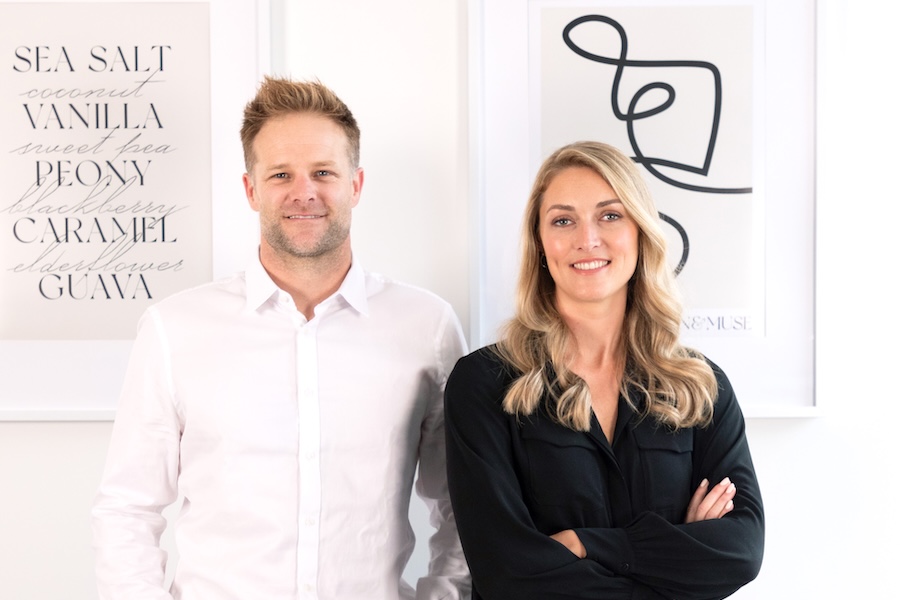

When Grant Taylor and Renee Stuart sat down to compare notes after a recent trip to the United States, the maths didn’t look right.
“We’d generally come back and go, well, maybe there’s an opportunity from three out of six of the meetings,” Grant says. “This time, we came back thinking, wow, we might just have created six good opportunities.”
That kind of result has become a pattern at MOXX Brands. In just over five years, the Auckland-based FMCG company has launched six brands across more than 7,000 retail doors in six countries, signed deals with Walmart, Target, Wholefoods and Costco, and done it all without taking a cent of external funding. In November 2025, MOXX was named the third fastest-growing company in New Zealand at the Deloitte Fast 50 Awards, posting 512 percent revenue growth over three years. It also took home the gongs for fastest-growing exporter and fastest-growing consumer goods business.
For a product business – in a market where the fastest-growing companies are almost always software – that’s an outlier result.
“Usually that’s a tech business that can scale that fast as they don’t have to fund physical goods with their growth. People keep asking us, how are you doing that in FMCG right now?” says Renee.
A different kind of FMCG start-up
MOXX was founded in early 2021, in the middle of the COVID disruption that pushed shoppers into supermarkets and out of department stores. Grant had recently exited his previous business, Rascal + Friends – an exit that became publicly contested and was eventually settled in the High Court in 2025. He’s candid that the experience shaped what he wanted to build next.
“Obviously well documented, my exit from Rascals wasn’t a great thing. I sat down and went, what were the downsides? One brand, one product. If a market shifts or someone does something wrong, all that value can go overnight. So the thought process behind this was diversify and make a stronger business,” he says.
Renee, who had worked her way up to Global VP of Marketing at Zuru before leaving, brought the brand and category lens. Together they set out to do the opposite of what most FMCG founders do, instead of hero-branding one product and trying to extend, they built a house of brands from day one.
“So many people start out with one hero brand and they get really locked into it. Being multi-brand has actually become our biggest strength. We can develop in different categories, we can cross-category develop very quickly, and retailers trust us to do that. It also de-risks our NPD and de-risks the business,” Renee says.
The portfolio now includes restor, everblue, Maison&Muse, Atomic, Kinzie Kids and DoseTheory, spanning candles and diffusers, haircare, laundry and personal care. Renee says many of these brands started as “reverse briefs” from retail partners: Instead of pitching a finished product, MOXX asks category managers where they’re struggling and builds to solve it.
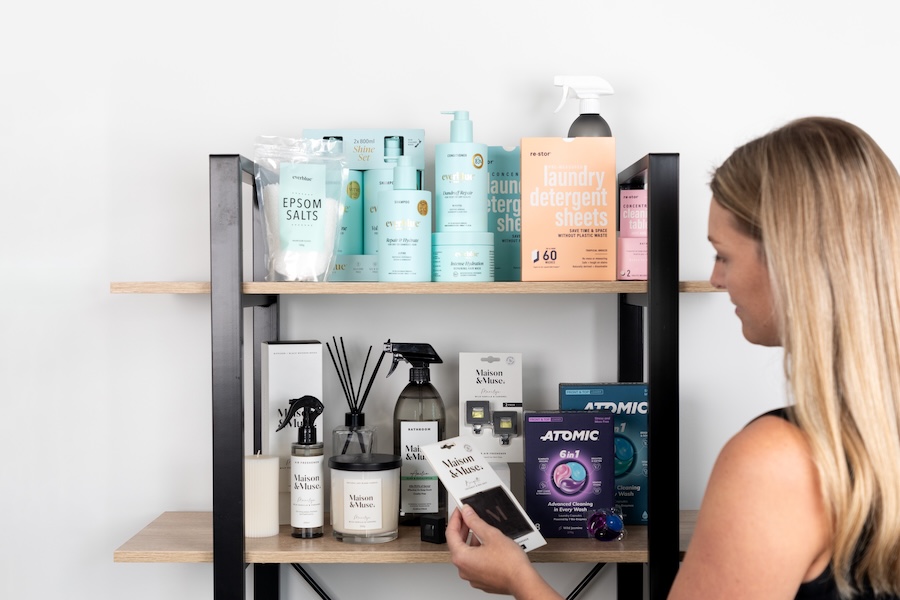
Renee Stuart with the house of brands she and Grant Taylor have built, from candles and haircare to laundry, across just five years.
“A lot of people will go in and talk 90 percent of the time about how amazing their product is. We go in and ask: What problems do you have?” says Renee.
Earning the right to be on the shelf
That posture has paid off. MOXX has the number one sold candles, diffusers and laundry sheets at Woolworths Australia and New Zealand through restor and Maison&Muse; brand positions built by partnering with the category buyer on a problem, then turning around a product in a couple of weeks for them to test.
Grant argues that experience matters enormously in those conversations. “Category managers talk to multiple companies every day – they’re busy people. They’ll put you in the too-hard basket if you need a lot of handholding.”
The retailer’s actual question, Renee says, isn’t about the product at all. “Supermarkets have so many brand choices. Their bigger problem is can you execute? Can you deliver at scale? Will your in-stocks be good? Can you market it well enough that it actually sells? Those are the things they need you to cover off.”
MOXX launched into Australia about 18 months after its first New Zealand listing, and it was that move – not the home market – that changed the trajectory of the business. Two years in, the founders were asking each other whether they’d survive.
“The revenue was there, but the profitability to invest in growth and bring on more staff wasn’t. Once Australia got going, that started changing quite a bit,” says Renee.
Grant spoke about treating New Zealand as a proving ground. “A lot of people think New Zealand is a great test market and there’s definitely up side, but it hasn’t defined whether our brands are going to be successful in Australia, and I don’t think it this should put business off from exporting – especially in non-food.”
The economics tell the story. A shampoo MOXX sells for $9 in New Zealand can sit at $15 in Australia. “That’s margin we can put straight back into marketing and into the people building the brand,” Renee says. The Maison&Muse launch into Woolworths Australia went viral, and the campaign became the proof point that opened the door to the US.
“The US looks at New Zealand and sees a 180-store retailer, and that’s tiny to them,” Renee says. “We could show them brands that worked in 1,000 stores at Woolworths Australia. That changed the conversation.”
“We took a couple of years of getting the doors knocked back before they opened. Plenty of nights I sat down and thought, are we doing the right thing here?”
MOXX has scaled across six countries without raising. It wasn’t ideological at the start, but it’s now a defining feature of how the company operates.
“We’ve been lucky we haven’t had to take external funding. When you take it, there’s another voice in the room. They might not see your vision fully. If you’ve told them you’re going to do X to get the money, you have to commit to doing X, even when Y might actually better for profitability or strategy. We have pivoted a lot,” says Renee.
Grant adds the practical side: “We can sit in a meeting and decide on something very quickly. We agree on direction 99 percent of the time. And we’re not driven by pulling money out of the business, everything goes straight back in for growth.”
That self-funded posture also explains how MOXX has been able to act on all six US opportunities from a recent trip, where most companies would have had to pick two. “We’re putting everything back in. Let’s try and execute all six.”
Be bold and do things differently
The MOXX mantra – Be bold. Break The Rules. Get Sh*t Done – emblazoned on the company’s website, was written when there were two staff. Renee says it was a deliberate statement of how a small team could compete with multinationals.
“If we think and behave like the bigger companies, we will lose as we can’t compete with them on spend. We need to think differently and cut through in different ways. And as a start-up, you have to execute. Strategy is just a piece of paper if you can’t execute it.”
Grant frames the “break the rules” line not as rebellion but as efficiency. “There are a lot of steps in the middle that you don’t need to take from A to B. Remove all the stuff in the middle and just get there faster. That creates efficiency, which means more margin for the retailer and better prices for consumers.”
The company is now 17 people, and Renee says holding onto that start-up energy is one of their biggest challenges. Hiring is deliberately slow – one recent role took nine months to fill. “We’ve learned we can teach people how MOXX operates and what to do but we can’t teach someone to bring hunger, hustle and initiative to work every day.
To keep the team pulling in the same direction, MOXX sets a single annual growth target and ties an entire-team incentive to it. Hit it, everyone goes on a trip. Last year it was Bali. This year’s stretch target is 100 percent year-on-year growth.
Lessons from the front line of export
For all the growth, both founders are quick to point out the lessons that came the hard way.
On compliance: “Don’t skimp on it,” Grant says. A minor labelling error early in the US cost MOXX a significant amount to pull product off shelf and relabel. The fix was to work with dedicated compliance experts in each market, rather than assume one person could cover them all.
On tariffs: When the US-China tariff turmoil hit, MOXX kept shipping while many competitors paused. “We just said, keep shipping. Everyone’s in the same boat. We weren’t the problem child with the retailers, and that’s helped us long term – even though it hit our P&L at the time.”
On commercial discipline: “People starting something new concentrate on the goods and try to add the commercials in afterwards. You’ve got to have the commercials to make it work first, then add everything else on top.”

The everblue range by MOXX Brands.
The founders say that the US will be the biggest growth driver over the coming year, forecasting roughly 75 percent revenue growth in FY26, and there’s further scope for Canada and the UK. Both markets have a strong beauty-pharmacy channel that suits brands like Maison&Muse and DoseTheory, though Grant is wary of UK supermarkets after his Rascals experience: “Five players, very competitive, very difficult.”
Asked what Kiwi founders chancing growth might be getting wrong, Renee’s answer is simple: Don’t let New Zealand’s scale set your ceiling. “We can build globally competitive brands from here. We have. The question is whether you’re willing to design for those bigger markets from day one, and whether you’re willing to listen to the retailer when they tell you what they actually need.”
Grant’s closer is more direct. “Strategy is a piece of paper – go get sh*t done.”
Five takeaways for SMEs from the MOXX playbook
- Pitch the problem, not the product. Ask category managers what they’re struggling with before you tell them what you’ve built.
- Don’t let New Zealand set your ceiling. Australia’s pricing dynamics in non-food often make scale economics work where New Zealand can’t.
- Diversify across brands, not just SKUs. A portfolio approach de-risks the business and earns retailer trust faster.
- Build the commercial model first. Margin, pack size and price point come before brand story. Without them, the rest doesn’t scale.
- Treat compliance as strategic, not admin. In-market experts are cheaper than a recall.