

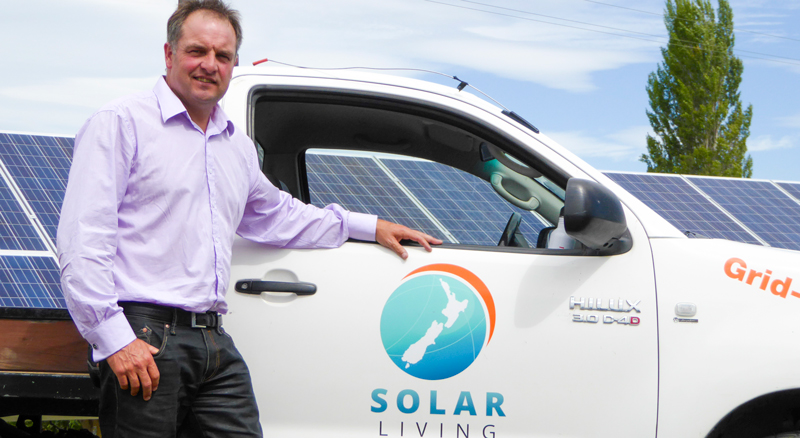

Starting a business is tough enough in these volatile times. But when large and well-established companies in the industry you’re trying to get a foothold in gang up and target a misinformation campaign at you – that’s when you really need to dig deep.
It’s also rare for an SME owner to sell a profitable construction business after 20 years and start over again in a more challenging industry.
Such are the experiences and times of Jason Tobin, founder of Christchurch-based renewable energy business Solar Living – winner of the ‘Most Outstanding Triumph Over Adversity’ category in The David Awards 2016 for his team’s work in overcoming massive opposition.
“Money has never been my driving factor in life,” explains Jason. “Growing up, I was fortunate enough to be surrounded by family who taught me it’s more important to help others.
“This fundamental belief supported my passion for the environment, and the idea that our decisions today will impact future generations.
“Climate change is one of the biggest issues facing our world, and I got tired of waiting for our government to address it. I’ve always been excited by the possibilities of new technology and I love taking on challenges to stay motivated. So, I thought I might as well get started.”
Jason adopted the recommended classic approach, spending a year researching. Travelling to Japan and Australia to study how others were using solar technology, and forming relationships with suppliers and supporters. When he finally established Solar Living in 2012, he reckoned he was at the forefront of something great, but felt not everyone could see that potential.
“New Zealand’s small-scale renewable energy sector was still forming. Hardly anyone in Christchurch had any real experience working with grid-tied solar systems. There were no courses, no qualifications and I had to adapt what others were doing overseas,” he says.
Jason also had to absorb losses for 18 months as he patiently explained the benefits and savings of solar energy, and clarified the misinformation spread by electricity retailers, until people started seeing the light.
“Now we have some of the happiest customers in the world. Each month people send us charts of how much electricity their system is generating; how much they have saved each month; or energy bills showing how much money their retailer owes them.
“It’s easy to stay motivated when the benefits of what you’re doing are so clear and appreciated,” he says.
But that doesn’t mean Jason’s struggle is over.
“There’s no doubt that solar challenges the current energy system. Electricity retailers see customers generating their own power as a threat to profit margins, and so do everything they can to discourage it.”
According to Jason, energy companies Meridian and Contact Energy paid around 25 cents per kilowatt hour (kWh) for surplus electricity sent back to the grid in 2014. That December, electricity companies across the board slashed their buy-back rates to roughly eight cents per kWh.
He says this move is entirely out of step with what’s happening in other countries, where small-scale solar generation is actively encouraged. In New Zealand customers can expect a very different response from the energy companies.
Solar Living customer Tony Crafts picks up the story:
“When our solar panels were installed, the power company wrote to us saying they were decreasing the buy-back rate to bring it in line with what other power companies were paying.
“To my way of thinking, what they were really saying was: ‘We want to make more profit by giving you, the customer, less’.”
Solar Living then designed a system to help the Crafts use more of the electricity they generated instead of sending it back to the grid. Their total annual energy bill for 2015 was $601.78; an average power bill of $50 per month.
“They have gained energy freedom from the big electricity companies, literally by taking some power back,” says Jason.
Energy for construction
Jason is also buoyed by the fact that his construction background has been an asset.
“More people are asking building companies about solar, and I’m able to answer the tricky questions around incorporating renewable energy into construction projects.
“Solar systems are all about energy generation, so understanding roof-area requirements and load-bearing has certainly come in handy during the design phase.
“The other important issue is ‘passive design’ and making homes more energy efficient. My experience has allowed me to advise clients planning on building or carrying out renovations to create a naturally warmer home with lower energy bills.”
Energy efficient smart-homes, and rapidly changing technology mean the price of solar panels per watt has fallen from $140 in 1975 to just $0.47 in January 2017. Between 2009 and 2015, the total amount of solar power able to be generated worldwide grew ten-times over.
Solar panels, battery storage technology and electric cars are becoming cheaper, more efficient, and more popular each year, he says.
“I’m excited by the future of solar and where it can take us. Some customers are charging their electric cars with the solar electricity they’re generating during the day. That’s like filling your car with free petrol, and there are no carbon emissions. The benefits for our environment and household savings are enormous.”
People are also using new technology to find their way around the energy establishment’s constrictions.
“Currently, excess solar electricity flows into the power lines, where you’re credited around eight-cents per kWh. [It’s then] sold to your neighbour’s home for 32 cents per kWh.
“Power Ledger has created a peer-to-peer electricity trading network to level the playing field, allowing solar generators to negotiate their own price and sell their excess electricity directly to their friends, family or neighbours.
“A trial network is underway in Auckland and I can’t wait for the results,” Jason says.
Jason’s environmental commitment extends to volunteering with a local charity, restoring native plant communities.
His advice: “Align yourself with individuals who share your passion, and never, never, ever give up.
“For some people, a job is just one way to pay the bills. I know what I’m doing is having a positive impact on my community and the environment, so there’s no way I’m going to stop.”
Kevin Kevany is a freelance business writer. Email [email protected]