

There is nothing like the fear of missing out on an idea to spur new tourism entrepreneurs into a market. At least that’s the way it worked for Mark and Laurel Morrison in setting up Wildwire Wanaka: Twin Falls ‘via ferrata’.
Mark Morrison explains that he first had the idea of a via ferrata in New Zealand in 2007 – but then life and the GFC got in the way. However, some years later he heard a new tourism adventure business was starting in the region.
“My first thought was ‘God, don’t let it be a via ferrata’.”
It wasn’t, but that was the spur Mark and wife Laurel needed to start work on their venture.
Via ferrata literally means ‘iron road’ and it is usually associated with World War 1 when they were used to help transport troops across steep mountain ranges (see sidebox).
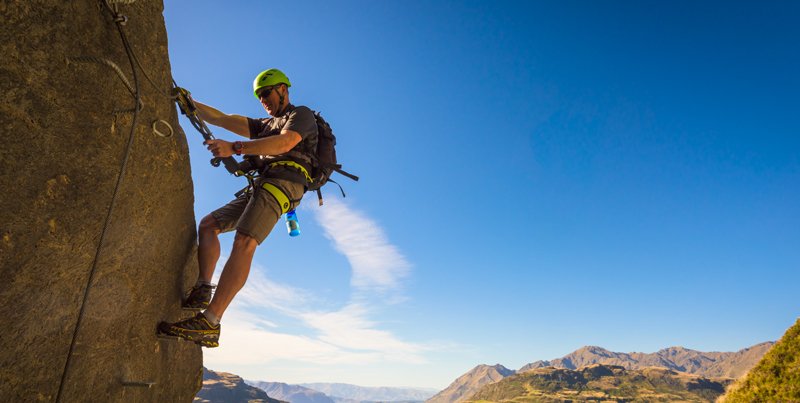
Wildwire Wanaka’s via ferrata involves a 1000-metre steel cable that runs alongside the Twin Falls waterfall, periodically fixed to the rock.
Climbers are secured to the cable and climb using iron runs, pegs, bridges and ladders – allowing them to climb routes that may not have been accessible otherwise.
And climbers don’t need any experience to enjoy a via ferrata walkway.
Wanaka Wildwire goes 400 to 450 vertical metres up the twin waterfalls but, as water does not fall in a straight line, climbers traverse about 1000 metres to reach the top (although Wildwire does have a gentler climbing experience which doesn’t go as high).
The company describes Twin Falls as a “spectacular double waterfall that flows dramatically though a series of pools and free hanging waterfall sections”. It is built on private land close to Treble Cone Skifield, on the road to Mt Aspiring National Park.
The couple, who have two children, met in Antarctica at Scott Base. Laurel is a glaciologist and was working as a field assistant. Mark is an adventure guide who at the time was working as an official Antarctic field trainer. He has worked in the adventure sector for 25 years.
Since setting up the business 18 months ago they seem to have had a dream ride.
Even when pressed, Mark says they haven’t, as yet, struck any problems. They were fortunate to start in a hugely buoyant time in tourism and their home town of Wanaka is going ahead in leaps and bounds.
Mark says they had been bracing themselves for something to go wrong when going through the consent process and in building the via ferrata with friend Martin Wilson of Abseil Access – the rope access engineering specialists who designed and engineered the project. But no major hurdles have reared their heads as yet.
However, Mark is conscious that there has to be a dip in tourism numbers at some point and that they are currently riding a wave. So being in a position to deal with lower numbers is important. “Basically, we don’t want to overcapitalise early and then struggle when numbers dip.”
Spreading the cost
It hasn’t been cheap to set up the company, with more than $250,000 invested. But the costs were spread across the company’s three partners – Mark and Laurel; Mark’s father John and stepmother Pauline Morrison (John is best known as an international cricketer and media personality); and Martin Wilson.
The company has also secured a $250,000 Tourism Growth Partnership grant through the Ministry of Business, Innovation and Employment which they have used to build the final stage of the via ferrata and for marketing over the next three years.
“The process [to secure the grant] was very hard and a few times we nearly gave up, but perseverance was the key,” says Mark.
Those tourism grants have recently been rolled into another fund, but as their project was already approved it will still get the MBIE input.
Mark’s business philosophy is “just going for it and going all in” and that’s the advice he would give to others thinking of launching a business.
“Firstly, I would say get excited about it. Sit down and look at the numbers. Consider what is the best case financial scenario for the business. If this is good and it is going to make you a fortune and it’s something that will make you happy. Then go for it.
“I like going all in, too. Like the ship’s captain that went to battle on an island. Hopelessly outnumbered [when] he landed on shore [he] instructed his men to burn the boats. You have no option but to succeed.
“If retreat is the easy option then often human nature will force you into that option.”
Looking ahead
In the longer term the couple hope to be in a position to be able to invest in other innovative ideas and provide other people with the opportunity to start their own businesses. Mark says having worked with young people in the adventure sector in the Central North Island for some years it’s inspiring to see them open their eyes to the outdoors and see what is possible for them.
While they both have lots of experience in the adventure sector, is it different knowing this is their own business and they would be liable if anything went wrong?
“This is interesting as when you are guiding in the outdoors, the worst case scenario for something going wrong is that someone (including the guide) will die. So now that we are running the company it isn’t a step up, it is more of the same.
“The team at Skills Active has been really helpful while we got our OutdoorsMark accreditation too, so we can have all of the appropriate systems set up.”
As to working together as a couple Mark says it’s great.
“We have worked together a lot over the years. Besides we bring up two kids together, that’s way harder.”
____________
What is a via ferrata?
According to Wikipedia, via ferrata dates back to the nineteenth century, but are often associated with the First World War, when several were built in the Dolomite mountain region of Italy to aid troop movements.
Many have been developed in recent years as their popularity has grown and tourism benefits have been recognised.
More than 1,000 via ferrata now exist – mostly in the Alps and most notably in Italy and Austria.