
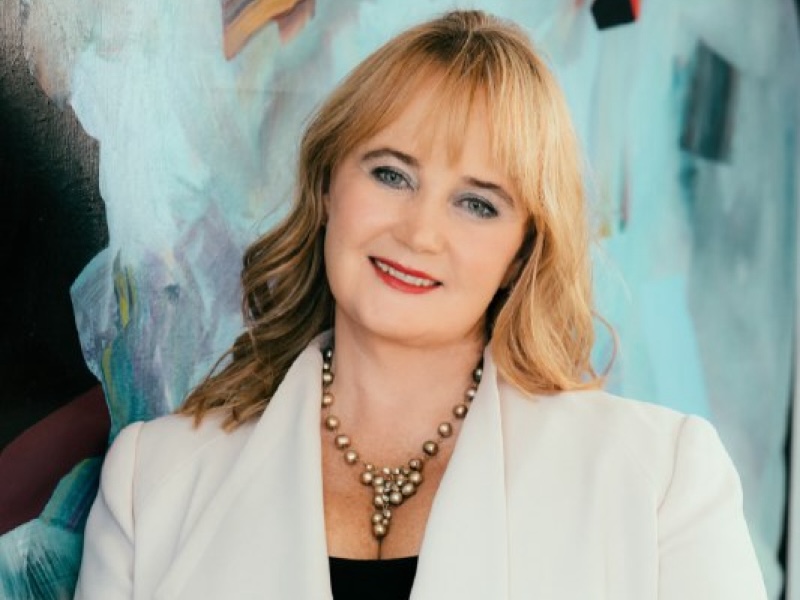

Pictured above: Linda Jenkinson.
Linda Jenkinson is a global entrepreneur with local roots giving growth advice to Kiwi companies. Tapping into the her years of business smarts, this World Class New Zealander offers up sound advice for SMEs looking to scale abroad.
After building, scaling and successfully selling companies for the past 30 years, Linda Jenkinson, who hails from Aotearoa, is a magnet for business talent, an entrepreneurial pioneer and visionary.
She was the first women CEO/ Founder to list a company on the NASDAQ stock exchange with DMSC, the $250 million on-demand courier company she co-founded that was described as being like Uber, before Uber. She went on to establish a global customer and employee experience platform, sold to the Accor hotel group, and WOW for Africa which is an NGO supporting women entrepreneurs in Senegal.
She’s now developed an exclusive programme, LevelUp, to support other CEOs and business owners to achieve their growth aspirations. Led by Linda herself and other centurions (people who have built 100M+ companies) who want to pay it forward, helping others just as they were helped.
“LevelUp is all about reimagining your business to grow, whatever that means for you. I work with SMEs on building their businesses to hundred million dollar companies whilst eyeing out offshore markets. I run three or four of these programmes a year in which I tap into my incredible upbringing in New Zealand, having come from a small business family, and the business education I’ve been lucky enough to receive over the years. At the moment am helping more than 35 New Zealand companies on this journey, and would like to help hundreds more build bigger companies,” Linda says.
Growing up in the family business in Palmerston North, Linda says that entrepreneurship is in her DNA, and something that is intrinsic to the innovative way in which Kiwis approach business.
Dialling into our conversation from her home in San Francisco, the 2021 UCOL Palmerston North Alumni Achievement Award recipient is preparing for a panel she’s part of on Kiwi innovation at South by Southwest in March.
“I think New Zealand has always been really innovative with many small companies going on to develop something that’s unique to New Zealand. Many then go on to explore taking that innovation offshore, and I think Kiwi companies are getting more experience in this which is adding to the entrepreneurial evolution we’re currently witnessing.”
Linda believes this process of learning is really important to talk about because it’s not an easy thing for companies to do. “I sort of see it as we’re laying the tracks for [growth] and there’s just more happening, which is really great. When I moved to the US years ago, you’d never see a New Zealand product on the shelves, and now you go to Whole Foods and I recognise Fix & Fogg from Wellington. That’s an external manifestation of how entrepreneurial innovation in New Zealand has changed over the past 25 years or so,” she says.
Despite being US-based Linda is a keen supporter of several local entrepreneurs with whom she has worked. “I’ve got entrepreneurs like Veronica H-Stevenson at Humble Bee who’s in the biotech space and is doing something completely innovative to Guy and Matt Hobson who were one of the first in the hard seltzer space with Native, but they just wrapped their company up, learned a lot about taking things offshore, built capability and are now looking at what do they do next.
“I’ve got lots of examples of companies that I work with and have encouraged them to spend time in the US and really understand what innovation looks like because when you see it, you can do it. And I think that’s the [US] really mirrors what the potential is for growth and innovation.”
For many SMEs however, tapping into growth markets proves to be quite challenging despite the huge potential that exists. Linda acknowledges this, saying one of the biggest challenges is the scale and size of the New Zealand market. “New Zealand is a tiny place, so most businesses have never experienced being in a place that has great scale such as China, the US or Europe. Sometimes their businesses are too broad because they’ve had to be broad to survive in New Zealand, and they wait too long to go international because they need to be more niched to be successful.
“One of the things I really see is that folks spend too long [in the local market], rather than saying, ‘actually I want to build a business, where’s the best market to be building it in?’ Prototype it here, and then build it concurrently in other markets.”
Getting the right advice is another stumbling block Linda sees tripping up a lot of companies as they eye out grow in international markets. “People who have done business in New Zealand or even in Australia don’t understand what scale means. And so making sure you get the right sort of advice to support you on your global journey is really important. As Kiwis, we’re very engaging. People want to help. It’s not a hard thing to do, to go and find some really great offshore advisors to help you on that journey. And I highly encourage New Zealand companies to do that.”
And finding that advice? It’s often hard for people to find specific advice as to their own business interest. How does Linda suggest finding or tapping into people or mentors who can offer such scaling up or growth advice?
“Well, the easiest way is to attend trade conferences in markets you are looking to enter. Meet like-minded business people and network. Once again, I very much focus on America because America has a mindset that if you win, we all win. So it’s very easy to build relationships and get that sort of support or go to a company which is bigger in the space or in an adjacent space or in that market, it works really well here.”
As for when is the right time to grow beyond your borders, Linda says that once you’ve analysed the market opportunity it’s a combination of ensuring that market is right for your offering at that specific time and then test, and analyse.
“Ask yourself, is there an opportunity in the market for someone new to come into it, will my offering provide or respond to a disruption in the market? And then test, it’s all about coming up with a whole set of different strategies and testing them to see what’s going to work.
“I would say Kiwis wait too long to be testing in two markets at the same time rather than one because you might get different results. And so one of the great things about today, and there’s been some huge negatives and challenges with Covid, but one positive is the concept of remoteness isn’t as much of an issue. So there’s no reason why you can’t have customers in multiple countries at the same time.”
Linda says she is very analytical about scaling to other markets. “I’ll go and analyse the market, its size and opportunity, and then get on a plane, go to some conferences and experiment in terms of what’s wanted and needed. Some companies thrive in New Zealand and grow, and others thrive by building out a much more of a global footprint a lot earlier than what you might’ve done in the past without the likes of cloud technologies.
“It’s all so easy now compared to what it used to be like with the constraint of physical distance. This constraint isn’t really there anymore, so go out and make it happen.”
This article was originally published in the NZBusiness March 2024 Digital Issue. You can read the issue for free, here.