


Kiwi SMEs are heavy on growth intent but light on execution when it comes to AI and automation, says ASB Executive General Manager of Business Banking Ben Speedy – and closing that gap is the central wager behind a new national programme the bank has unveiled this week.
Pathway to Productivity will target more than 4,100 businesses in its first year, bringing together an AI bootcamp delivered with Xero and academyEX, a placement programme pairing SMEs with Master’s-level AI, data science and engineering students through the NZ Product Accelerator, and one-to-one consultancy support for medium and large manufacturers. Registrations open on 18 May.
But the most useful takeaway for an SME owner wondering where to even begin with AI is, perhaps, the most boring: Pick one problem.
“The most impactful AI use cases for business go beyond personal productivity or workflow, they target core areas of the business,” Speedy says.
“So we would suggest starting there with one real business problem, and test how AI could solve just that. Don’t try to overhaul everything at once.”
That advice cuts against the noise of an AI news cycle that has SMEs reading three things a week and still uncertain where to put their first dollar.
Speedy is candid that the productivity question is bigger than a banking one.
“We’re seeing strong intent from businesses to grow, but constraints in turning that into action, particularly when it comes to embedding AI and adopting new technology,” he says.
“Many businesses are still relying on labour-intensive ways of working, rather than investing in automation or AI, which is where the biggest opportunity for productivity growth now sits.”
His own metaphor, used at the programme’s launch, captures the gap: “While we have spades, international businesses have excavators.
He says that Kiwi businesses are often trying to compete without the same tools and technology as their overseas counterparts, and the gap is widening as AI takes hold.
“Too often, our productivity challenges are approached by adding more people, rather than investing in automation or AI. Pathway to Productivity is about helping businesses step up to the excavators, with practical, evidence-based solutions, that can genuinely lift New Zealand’s productivity.”
The argument shaping the programme is that capital alone doesn’t close the gap.
“Conventional banking levers alone don’t solve that. There is capital to back businesses to invest in unlocking productivity, but businesses need to be backed with insight on what to invest in, and they need the capability then to execute.”

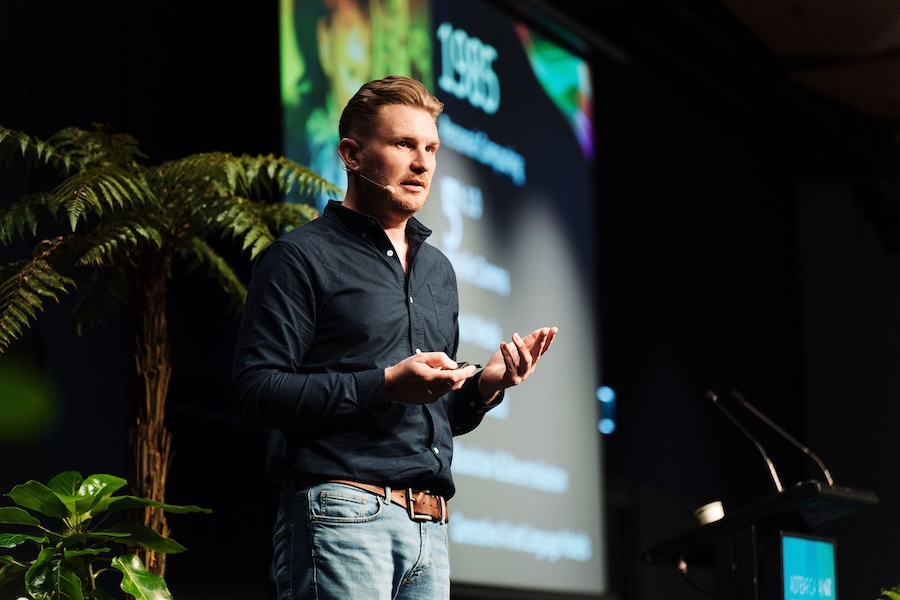
Ben Speedy is ASB’s Executive General Manager of Business Banking.
That’s a notable framing in a market where most productivity conversations get parked at the door of government or industry bodies. Speedy says ASB’s own research has been clear that the lead has to come from business.
“Recent research we commissioned showed that business, not government, should lead the charge on improving productivity in NZ. It highlighted business needs to embrace innovation and invest in capital, knowledge, research and development, and advance technology adoption as an engine to drive growth.”
The bank has put numbers behind the ambition: $5.1 million in additional revenue, $44.7 million in cost savings, and up to two days a week per business freed up across the first year. Speedy says those figures are scaled from a 2025 NZ Product Accelerator pilot using average gains reported by participating businesses, with the AI time-saving estimates drawing on London School of Economics research and operational efficiency data from LMAC.
“For a sceptical SME owner, the strongest proof point is that this isn’t theoretical,” he says.
“Businesses in the pilot have already unlocked measurable gains. It’s practical, hands-on change with real results, not just advice.”
By the end of the 12‑week programme, participating businesses will have built an AI‑driven marketing campaign, a workflow‑managing AI agent, competitive market analysis, AI‑generated standard operating procedures, business insight briefs, and at least one automated workflow or agent. The banks also says that businesses will leave with a 30‑day AI implementation plan to support immediate adoption. The $1,350 per person cost of attending the bootcamp and 12-month access to an AI foundation learning platform will be fully covered.
For business owners, the editorial line is sharper than the programme detail. The intent to use AI is widely shared. The execution, and knowing how much and were to invest is where most SMEs stall. And on Speedy’s read, the way through isn’t a bold strategic AI bet, it’s a narrow one.
Pick one problem. Solve it. Then pick the next.
—
Pathway to Productivity opens for registration on 18 May.