
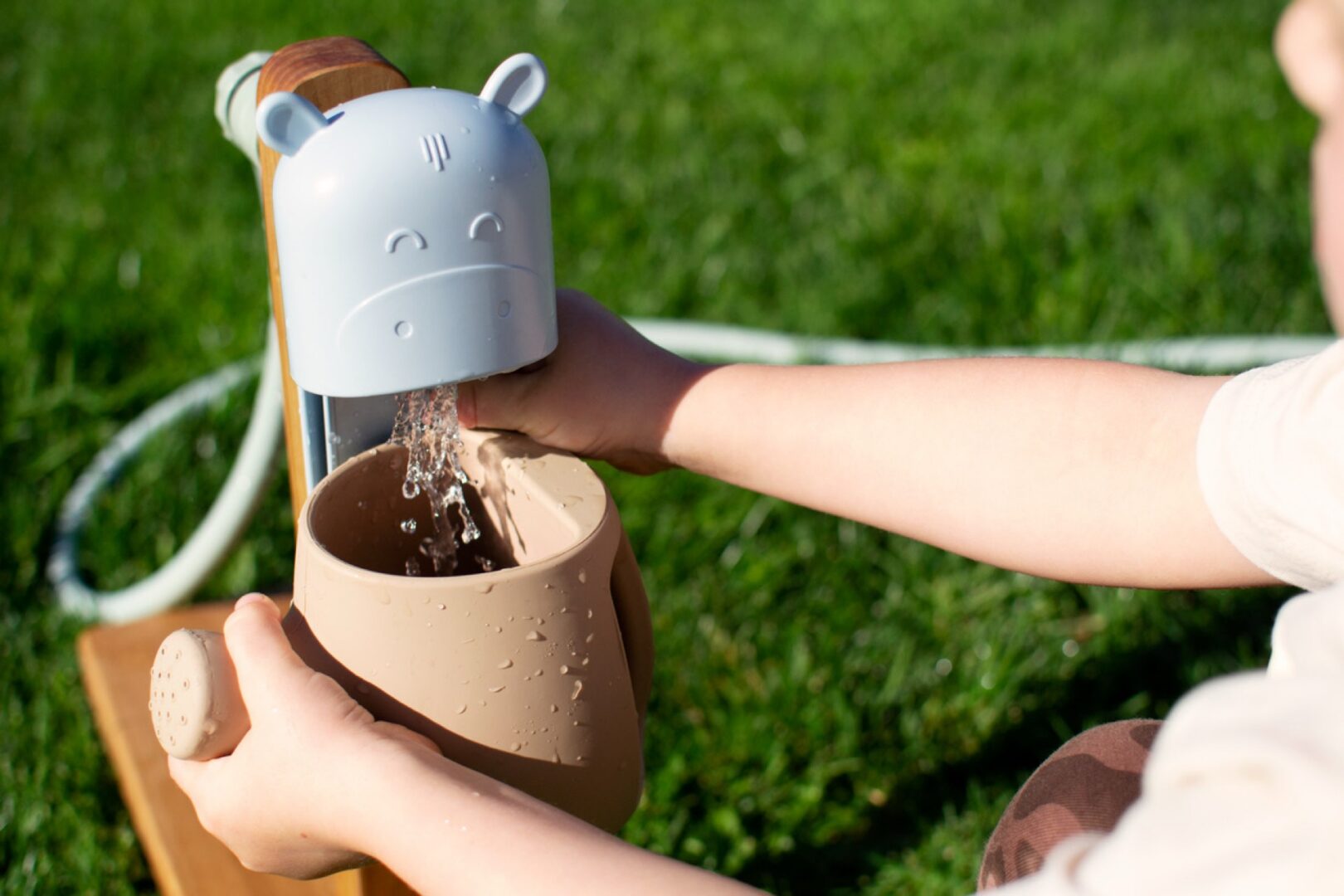

The problem showed up every day, usually on the kitchen floor.
Shelley Ebner’s son, now six, wanted water constantly, and if he didn’t get it, he found it himself. “He was always asking, ‘Mum, can you fill us up?’ And if I didn’t give him water, he’d find it one way or another, even if that meant pushing chairs to the sink and spilling it all over the floor,” she says. “I was mopping the floors every day. And it wasn’t that I didn’t want him to have the water.”
The outdoor hose was no better. “We’re on rainwater tanks, so I couldn’t leave the hose running, even on a trickle. The kids would play with the hose, then forget about it, and the next minute half the lawn’s flooded.” Hand her son a trigger hose, meanwhile, and he’d fire it onto the roof, at his sister, or into the lawn until he’d dug a hole. When her daughter came along, the whole cycle started again.
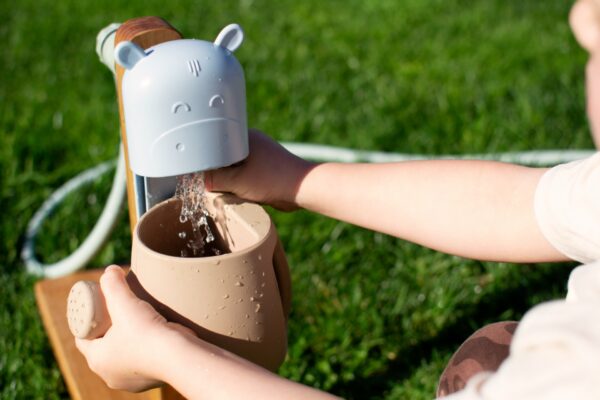
The breakthrough came from the fridge. At around 14 months, her daughter would drag a chair over, climb up and help herself from the water dispenser, spilling it everywhere. “I needed that exact mechanism, but outside,” she realised. “That was really the birth of the idea. We thought, if a 14-month-old can operate the fridge, they should be able to do the same thing outside with a tap.”
The first prototype was a collection of rough parts stuck to a piece of plyboard. It taught an early lesson: HapiTap needed to be much more than a child-friendly version of a trigger hose. The challenge was creating a mechanism that dramatically reduced the water pressure and controlled the flow, allowing children to enjoy water play with just a gentle stream. That, she says, “took away the pressure, which was the dangerous part of the hose – the ‘weapony’ part that would fly around everywhere.”
Then came the moment that convinced her. Ebner, a freelance branding and marketing specialist who had previously worked at a digital agency, was working from home while her 16-month-old played with the prototype right outside her office window, in clear view of her desk. Because the tap only runs while it’s pressed, there was no pool of water to worry about, and each press makes a small sound, so she could hear her daughter playing the whole time.
“She would sit out there and play, and I could work. I could see her through the window and hear her, so I knew she was okay. She would just turn and pour, turn and pour, for a whole hour.”
That left her thinking, “I can’t be the only person dealing with this.” A survey of other parents confirmed she wasn’t.
Where the complexity hides
Ebner had no experience running a business beyond freelancing, and admits that “ignorance is bliss” played its part. Her father, an inventor himself, was blunt. “He said to me, ‘Your thing is so complicated. I’d never make it – there are too many parts, and it’s such a difficult environment.'”
He had a point. Kids are rough, and water under pressure is hard to contain. Every internal part has to fit with near-absolute precision. “If some of the parts are even fractionally out, it doesn’t work.”
Ergonomics added another layer. For an 18-month-old, the spring pressure has to be low and the paddle’s travel short. But a short lever loses the mechanical advantage that makes a trigger hose work, and making the lever longer means small hands can’t reach it.
“I’ll never look at a toaster the same way. The amount of work involved in making something manufacturable is a huge learning curve in itself.”
Material choice was the trickiest puzzle. “It’s a chicken-and-egg problem. You can’t test the final material until you make the tool, but you have to make the tool for the material you want.” Each plastic shrinks at a different rate, so a tool is cut oversize to suit one specific material.
Working with a contract CAD designer, Ebner 3D-printed and tested design after design. But durability and material testing only became possible once she committed to tooling: Five tools for one product, where most startups begin with one. The tools were made offshore, because toolmaking in New Zealand is expensive and toolmakers are scarce, and every change meant another round trip. “Every change takes another two months.” All up, development took “easily two years”.
Funding it on a shoestring
Of the more than $150,000 invested, Ebner estimates at least 60 to 70 percent went into tooling, with design revisions accounting for much of the rest. The early stages were self-funded. Tooling was paid for with personal loans, including from family and friends, who are paid interest.
A business loan wasn’t realistic. “We had no income.” Investors, meanwhile, would have wanted a significant slice of the company.
Tooling’s payment structure (half up front, half on completion) helped, and so did her own skills. She built the brand and website herself, and funded marketing the same way as everything else. “I’d work like crazy for my other clients so I could afford to pay our CAD designer to make the changes. It was a constant cycle.”
With trial parts from the first tool run, HapiTap opened pre-orders. With just 700 Instagram followers, it sold 180 units in a week. “My husband was yelling at me, ‘Shut it down, shut it down!’ There’s nothing like that validation. People were actually buying – people I’d never met.”
Much of that early reach came through Instagram, including a former schoolmate turned ECE teacher with a parenting following, who backed the idea from the start.
Then a problem surfaced. Polypropylene, the standard material for kids’ toys, had already been ruled out because it wasn’t structurally strong enough. Nylon was meant to be the answer, and suppliers and material scientists were confident it would be. But a pre-release unit left outside under pressure began to stretch in the sun. “We’re talking about a miniscule stretch, but in some cases that could be enough to cause a drip.”
It took another year to fix. Without the budget for a commercial lab, she improvised. Six candidate materials went under pressure in a temperature-controlled crockpot for weeks at a time, cycling hot and cold to mimic outdoor conditions. “We’re not running a million-dollar R&D department. We’re on a complete shoestring.”
Many of those pre-order units are still working without issue, but any customer who does hit a problem gets a replacement. “They trusted us, they pre-ordered and they paid. We’ll send a new one to any existing customer who took a chance on us.”
The final product uses carefully selected, durable materials designed to withstand outdoor conditions and everyday use by children. A robot test rig clocked 82,000 presses, the equivalent of about 11 years with a child using it 20 times a day.
Why make it here
The parts are injection-moulded locally in Katikati by AVID, a manufacturing business run by her husband, Chris. The couple then assemble and pack the HapiTaps themselves. For Ebner, manufacturing locally provides reassurance and greater control over quality. “There’s a real sense of security in knowing exactly who’s making your product.”
People regularly ask why she doesn’t just manufacture in China. Making it locally means no huge minimum order (“I don’t have to order 30,000 units”) and shorter gaps between stock runs. Assembly costs more, but she believes New Zealanders are “happy to pay an extra $10 or $15 for it to be made in New Zealand, and to know it’s made from materials that are safe for their kids”.
The same thinking is why she isn’t chasing big-box retailers yet. “We’re in control of the product and we can talk to our customers. If there are any issues, we can do something about it. We need to walk before we can run.”
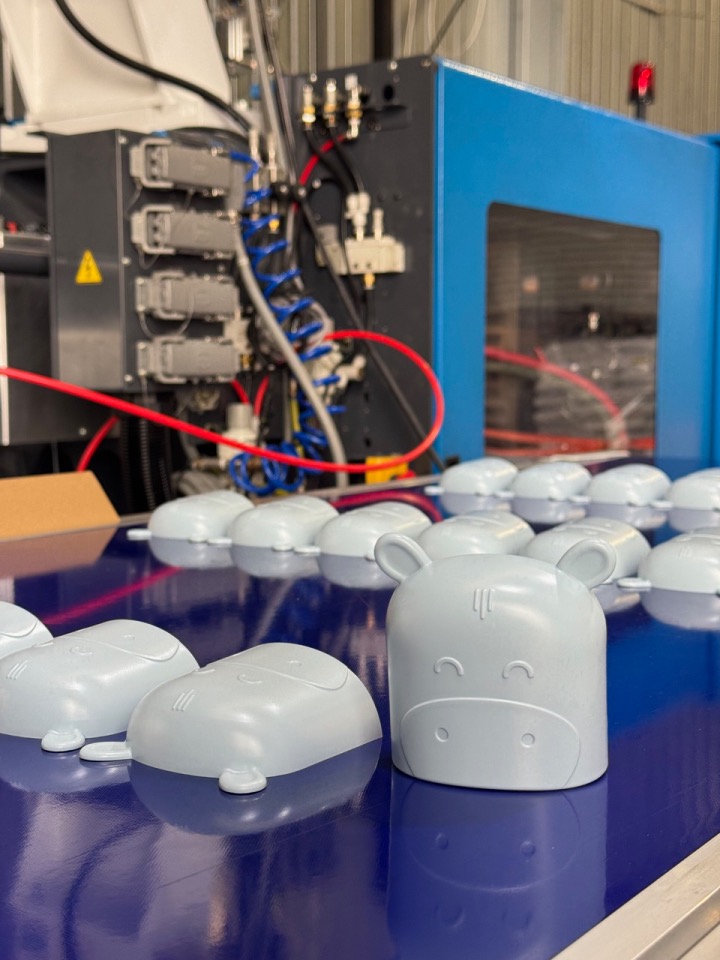
Freshly moulded Hippo HapiTap casings at AVID’s injection-moulding facility in Katikati.
Intellectual property has been an education of its own. “You might assume that if no one holds a patent for something, you can get one. That’s not how it works at all.” Anything that has ever existed counts against you, patented or not.
HapiTap received funding towards the legal fees for its initial patent application through a Callaghan Innovation programme that has since closed, and worked with an Auckland IP law firm. The process began with a provisional patent application to establish an early filing date, followed by an international application (PCT) to preserve the opportunity to seek protection overseas. But that’s only the beginning. Each country requires further investment, estimated at around $15,000 per country. HapiTap is prioritising the US, given the size of that market, while weighing up where else to pursue protection. A design registration is in place in New Zealand, with Australian and US design registrations underway, and she registered the logo trademark herself.
Gold, and what comes next
HapiTap recently won Gold in the Consumer category of Industrial Design at the 2026 Best Design Awards. That put it up against every consumer product entered, from a small team of Ebner, her CAD designer and manufacturer AVID. “We were thrilled just to be a finalist.”
Before launch, with around 360 people on the waitlist from a following of about 1,600, Ebner admitted, “I’m pretty worried we’re going to sell out again.” She was right. Early Access opened at the end of October and took 33 orders in under 90 minutes, and the initial production run sold out in a little over two weeks. More stock is now being made to catch the Christmas rush.
HapiTap has also started shipping to Australia. The US is the main prize. HapiTap has been completing the independent lab testing required there, which will let it sell through Amazon. The demand is already there: one customer in Hawaii tracked down a sold-out unit through Shopify’s product directory.
Early childhood centres are another opportunity. Montessori centres were among the first buyers, more centres around New Zealand have since shown interest, and because the water stops when a child lets go, children “generally share it quite naturally”.
Asked whether she’d do it again knowing what she knows now, Ebner is candid. “I probably wouldn’t have.”
The hardest part was going without a sounding board within the industry. Her attempts to find a mentor went nowhere. “You’ve just spent $90,000 on tooling, and you’re lying there thinking, how am I going to make this work?”
But the difficulty is also the moat. Unlike buying a product off the shelf and adding a markup, “how hard it is to get going means it’s probably just as hard for someone else to set up right next to you”.
Her advice to others, particularly mums with an idea, is simple. “You’ve just got to get out there and commit to it, and be willing to change direction and make it work as you go.”