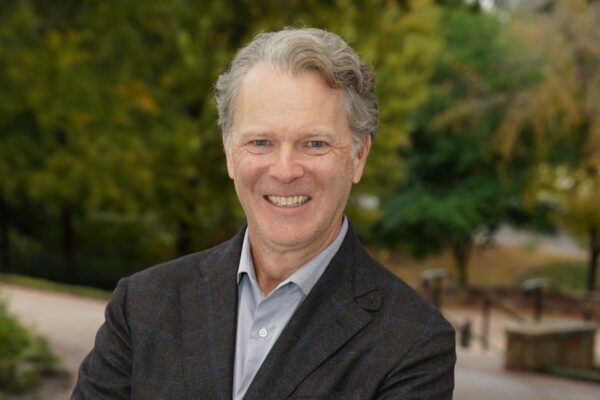

When David Littlewood launched Modern Office with Adam Hazlett in March 2007, little did he realise that in their first year they’d face economic chaos caused by the GFC.
I’m interviewing David via online video chat, and he’s sitting in a soundproof office pod – a recent innovation illustrating the dramatically changing approaches to office design in the post-Covid world.
Perhaps it was David’s non-traditional path into business that gave him the skills to ride the waves. Having left Tauranga Boys College after completing the sixth form at his second attempt, he managed to secure a job at the IRD. After two years there, his boss suggested he’d reached his limit in that role, which gave him the motivation to take up a cricket contract in Zimbabwe. A year later, he moved to the UK where he continued to play and coach, working to save money to travel.
Undoubtedly, his experiences living and working overseas planted seeds of resilience and adaptability he would harvest later.
David returned to New Zealand in 2002 and landed a role as key account manager for a national stationery and office products firm, which is where he met Adam Hazlett. Working together for several years, the two of them identified an opportunity to create a business in the office design space, and began to make plans. The idea did not go down well with their employer who saw the move as direct competition. They spent the summer waiting out a non-compete agreement while they continued to refine their business plan, only to find when they eventually launched Modern Office, that their disgruntled former employer had sabotaged their relationship with their supply chain.
Other than a credit card, a laptop and a leased car each, they had no resources to draw from and no Plan B: they had to make it work.
David and Adam fought for every contract in those early months. Then the GFC hit. A lot of projects that were potentially in the pipeline were suddenly put on hold. Everyone stopped spending money.
According to David, what enabled them to survive was the fact that they didn’t yet have many overheads. It was just the two of them, plus another employee, working out of a small office. They were earning half what they’d earned previously. In David’s words, “there was no back-up. We had no option but to fight for it. I had a wife and kids at home, and a mortgage to pay. We had to get out there and make it work. And we did.”
What followed was a tough couple of years, which gave them a solid foundation so that when things started to improve, they could grow. Sixteen years later, Modern Office is now the commercial project arm of the business. There’s plenty to keep them busy in Tauranga, with the city in the midst of a huge programme of redevelopment, but they also complete projects in other regions, with leads coming in through their website.
Online initiative
Ten years ago, David and Adam launched an online office furniture shop, Office Furniture Warehouse – one of the first online businesses of its kind in Aotearoa New Zealand, and now one of the largest online office furniture shops in the country, with substantial repeat business. Four years ago, they started a wholesale arm of their office furniture business. They were already importing most furniture for their commercial products from European and Chinese suppliers, and had a warehouse in Tauriko, so it was a logical step to move into wholesale.
According to David, the idea led to some interesting conversations with their competitors, but this has now become a successful part of the business, with great growth projections.
Covid’s impact
Apart from ruining David’s 50th birthday party, which had to be cancelled, Covid had a big impact on Modern Office. “But at least we had plenty of booze to see us through,” he laughs. “We needed it. That first week, sales fell to zero. We were wondering what does the future hold?”
The partners had faced a storm before. Communicating closely with their team, David and Adam halved their own salaries immediately. Staff agreed to work shifts and take overdue holidays. The government subsidy supported their salaries. Their landlord halved their rent for two months. David noticed how most people in New Zealand seemed willing to work together to get through the crisis.
Fortunately they were approved as an Essential Business after two weeks – people needed resources to set up home offices with the nation in lockdown. The online shop was allowed to open to dispatch office furniture and supplies, following strict guidelines to minimise contact.
So this helped the business survive. Recovery over the following two years exceeded expectations.
The future
I’m particularly interested in David’s take on the future of office design – most commercial spaces have adopted the open office layout, so how is this changing post-Covid?
He notes that people were already starting to work from home prior to the pandemic, it just forced the issue. People got used to the idea, and liked it. Lots of their own staff now operate flexibly, combining working both from home and from the office. As he says, “why drive an hour to work for a meeting or to do a job that you could be doing at home?”
Modern Office encourages flexibility, but they need to balance this with the need to have staff available to take care of customers in the showroom. David is a strong believer in the need for regular face to face contact for his team.
“Zoom isn’t the same as sitting round a table bouncing ideas off each other,” he says.
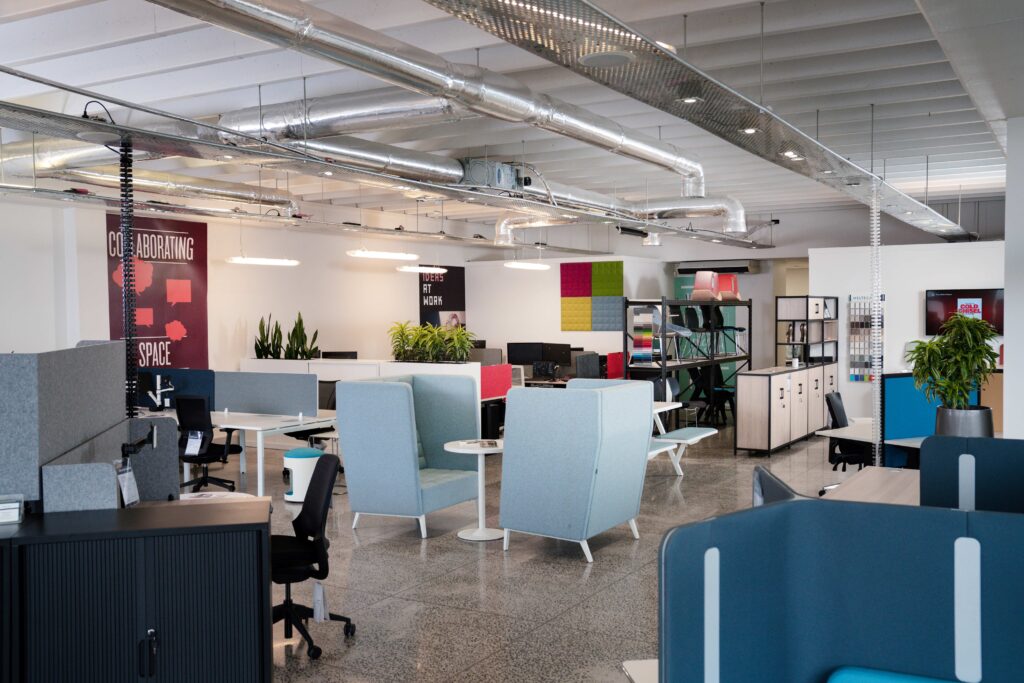
According to David, office design is changing rapidly. People are no longer stuck at their desks. Technology means you can work sitting on a couch, or at a bar-leaner for an informal meeting. Decorative screens, high-backed couches, flexible meeting spaces, sound pods and a range of other innovations are recreating open office spaces to mitigate noise pollution, and give employees far more choice about how and where they work, and with who.
The partners have an ongoing focus on environmental sustainability. They’re taking steps to reduce polystyrene and plastics in packaging, insisting suppliers use cardboard/recyclable material where possible. They’ve changed from chrome frames to powder-coat in their furniture manufacturing to reduce environmental impacts. They visit factories where furniture is made and only work with suppliers who have environmental certification.
As David says, “we’re a small business in a small country. But we’re always looking at ways we can do things better”.
His advice for aspiring entrepreneurs?
- Do as much research, preparation and planning as you can.
- Get good advice from people who know what they’re talking about.
- Don’t be afraid to ask potential customers what they think of your plan.
- Don’t be afraid to adapt your plan as more information comes to light.
David remains positive despite the imminent economic slowdown.
“Tough times produce opportunities and get rid of weaker players. It’s not easy, but the rewards are good. Your drive, your decision-making and your ability to adapt will see you through.”