
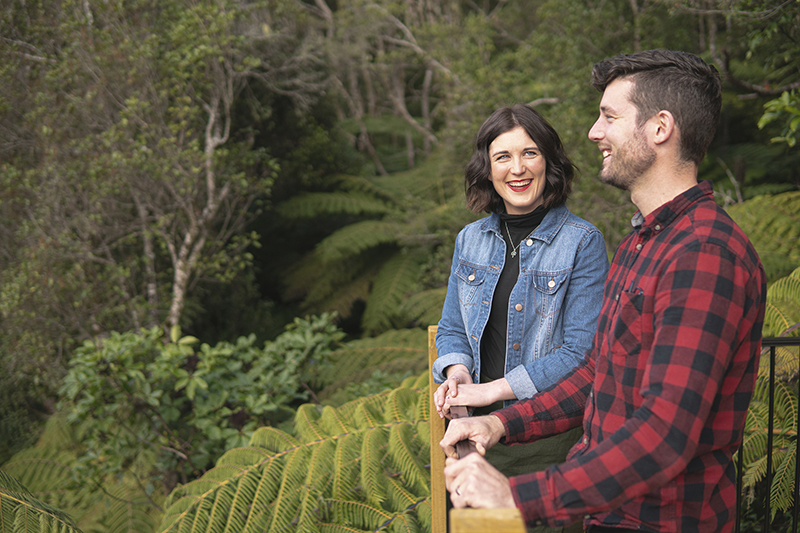

Based in the Hutt Valley, StudioC Design is a fast-growing co-design agency solving problems with end-to-end design services. Its founders Celeste and Glen Skachill are working the dream.
“This is what co-design is all about,” she explains. “And involving people and communities alongside you in the process.”
Celeste credits her nana Daphne for fostering her creativity, but also believes she gets her creativity buzz through nature. “It’s the place where you can get into a creative flow, which is why Glen and I built our work studio in the bush.”
Celeste had met her husband, a mechanical design engineer, through their shared passion for motorcycle racing. Fortunately, Glen has a flair for creativity too, particularly around solving problems.
The couple soon found that marriage is all about collaboration, and this carried over to StudioC, the co-design agency they established five years ago.
The ‘C’ in StudioC stands for co-design and creativity, their core essence, but it could easily stand for ‘communication’, which the couple believe is the key to a successful business partnership, along with respecting your partner’s skill set like you would a colleague’s.
“Business partners often have complementary skills, and this is true for us,” says Celeste. “Glen is super practical, functional, and pragmatic. Whereas I’m a ‘big picture’ dreamer. I push us creatively and innovatively and he grounds me in how we can practically bring an idea to life. “For example, I designed our studio and Glen had the practical skills to figure out how to build the space and deliver what I’d imagined.”
Celeste says the studio attracts clients who love nature and look to do things differently. “They love coming here for meetings and getting into a different headspace.”
Output is also influenced. Their studio retreat encourages creativity and invokes the mindset needed to solve problems.
Point of difference
End-to-end service, or a single point of contact for clients throughout the whole journey to creative delivery, is StudioC’s point of difference. “We want to work alongside clients throughout the whole process using co-design,” explains Celeste, “from understanding their customers and community, to planning strategy and then translating this vision into aesthetically beautiful, yet practical, designs.
“We work in partnership with organisations to create designs that create a better world for people.”
Design can be utilised to do good she believes, “that’s why we help support others trying to do good in the world”.
“We’re talking not just design that looks cool, but wholesome design that’s centred around people and making their lives better.”
StudioC has quickly built a portfolio of successful design projects in the five years it has been operating, ranging from designing a new mobile library cart for the Upper Hutt City Council, to refurbishing the foyer of Zealandia’s building in Wellington, turning a static space into a multi-functional education room and exhibition space. The latter project saw StudioC as the single point of contact for the client, managing all sub-contractors from concept to installation.
The Everyday Heroes Annual Appeal Campaign for New Zealand Red Cross was another successful project, designed to inspire people to support Red Cross’s humanitarian efforts in Aotearoa.
Thanks covid
When Covid-19 first struck New Zealand, StudioC’s work ended overnight.
“It was my absolute worst nightmare,” recalls Celeste. “It was terrifying. I lost all my creative motivation. I didn’t even want to go to the studio.”
After a rest and reset, Celeste utilised the downtime to update their website and revamp the business’s processes, working ‘on’ the business to come back stronger than ever.
“We took on slightly different work and shifted our workshops online,” she says. “Suddenly organisations wanted to develop their online learning, so we got involved in designing courses and training that’s fun and engaging.”
“Every e-learning project should have a designer to ensure it is centred on the user experience,” says Celeste. “We’re doing more and more of these types of projects.”
Today StudioC operates a hybrid model, with staff working one day a week at the studio and the rest remotely. Everyone has become proficient at using Zoom, she reports, so time spent commuting is significantly reduced.
What’s next?
Celeste and Glen have been genuinely surprised by the growth of StudioC, and although many people said they were mad to build a studio in the bush in the middle of nowhere, they’re glad they did. “It allows us to facilitate deeper connection and thinking,” says Celeste, “and people love it.”
The couple have big plans for the next five years, including the addition of a larger studio workplace in the bush for talks, workshops, retreats and a workplace centred in nature for wellness and creativity.
They want to be leaders in the practice of co-design, with a focus on conservation, education, healthcare and wellbeing, social services and the GLAM sector (galleries, libraries, archives and museums).
Celeste, a self-confessed workaholic, admits that owning and managing a business is the hardest thing she’s ever done – particularly learning so many skills in a short timeframe.
She’s grateful for all the support they’ve received and for the “really good people” who’ve come into her life at different times – such as her high school art teacher, “really gifted” lecturers at Massey, and various mentors.
“I would not be where I am without them. It takes an army of support over time to build a business.”