
NZBusiness + Management Digital Issue – December 2023
Future-proof yourself for success with leadership training.


Future-proof yourself for success with leadership training.

In this issue: Is the use of AI in business disrespectful to customers? Generative AI in the manufacturing sector. Deepfake scams: Every business leader should be prepared A “Lean” approach

Using his own intelligence, Bill Bennett discusses AI’s current and potential uses for business owners. Artificial intelligence is no longer the stuff of science fiction. It’s here and it’s all

Get your story right and it has the power to transorm everything you do in your business. Jacquie Walters explains how. I’ve come to understand that marketing success boils down

Richard Conway shares his company’s experience in transitioning to Google’s new AI Search Generative Experience. Everything is going to change. Whilst we have been using AI within advertising platforms for

Are you taking a short-sighted view on your marketing? Logan Wedgwood takes you down the road to lasting customer relationships. Let’s start with a thought experiment. Picture this: I’ve just

Kathryn Sandford has some timely advice for employers looking to attract, retain and develop top talent. Inefficient and antiquated hiring practices are not only preventing New Zealand businesses from attracting the right talent but also causing them to lose top performers at an alarming rate. Many businesses are struggling with too many gatekeepers, long and arduous hiring processes, and an unrealistic set of expectations and requirements for the current job market. As a result, businesses are left with a revolving door of employees, with high turnover rates and low morale. Furthermore, companies often desire top-notch talent, but they are unwilling to pay the high salaries that come with it, leading to a significant talent gap in the industry. This talent

2023 is proving to be a year of rejuvenation for Auckland’s embattled city centre. For its businesses renewed optimism is definitely in the air.

If you’re not taking cybersecurity seriously, you could well be the target of criminal activity. Bill Bennett walks you through the threats and your best. Phishing’ has been around since the dawn of the Internet, yet it remains New Zealand’s most reported cybercrime. It’s a way of getting past cyber defences by tricking people into handing over passwords or other key information. When criminals get this information, they use it to steal money, install ransomware or access private data. Cert NZ, the government’s Computer Emergency Response Team, says that in addition to passwords, criminals may be looking for your credit card or online banking details, or personal information and documents they can use to impersonate you – such as your

Cutting climate change action after the cyclone is like accelerating away from a crash with your wheels wobbling. Business needs better long-term leadership, writes Andy Kenworthy. Business owners around the country are still counting the cost of Cyclone Gabrielle. Its severity and the increased frequency of such events are symptoms of climate change. For decades we’ve been warned of the oncoming storms. Now they have come crashing into our lives. But the political response has been to cut climate change initiatives. This is stacking up uncertainty and long-term risks in the way of progress. As journalist Bernard Hickey put it: “Isn’t this the rainy day we’ve been saving for?” Apparently not. So far, the government has binned the Sustainable Biofuels

Thinking, look at the big picture and take a long-term view, writes Sophi Rose. Many SMEs will benefit greatly from the governance of a board, if it is scaled to match the needs and budget of the particular business. It’s a short sentence but there is lot to unpick in that statement. So let me back up a little and share a few ideas about what governance is, what is a board’s role and what ‘scaled’ means in the SME context. Governance You can find many definitions of governance and few good discussions on what should, or should not, be included in the concept. There are also a lot of misconceptions that boards are just for the ‘big operators’, risk

Jenni Raynish is the founder and CEO of New Zealand’s only cord blood bank. The former high-profile comms and PR consultant is thoroughly enjoying what has become her lifelong passion project. NZB: What sort of feedback did you get when you first decided to set up CordBank? Jenni: My Mum asked, “Why would you want to start something new when you already have a successful business?” But I was completely convinced that starting CordBank was something I just had to do. I was so frustrated that I couldn’t bank my children’s cord blood and no one else would be able to either unless I started one. I was 100 percent supported by my husband, who said “that sounds like

Thursday 30 July 2026 | 7:00am – 9:00am
📍 Covert Theatre, 51 Mackelvie Street, Grey Lynn, Auckland
Everyone talks about the importance of business strategy, but what does it actually mean in practice? Strategy trainer Ryan Sproull cuts through the jargon to give SME owners a clear, practical framework for thinking strategically about their business.
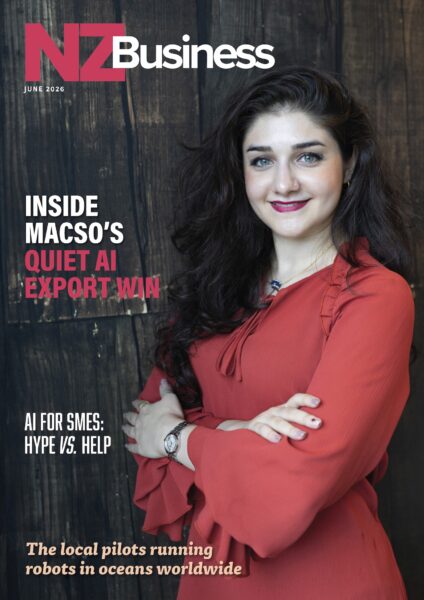
Practical AI insights, Kiwi tech innovators, and the tools helping Kiwi SMEs compete on a global stage. It’s all packed into this special tech issue of NZBusiness.